Skip to main content
Genetics
나의 코스
배우기
시험 준비
AI 튜터
학습 가이드
교과서적 해결책
플래시카드
탐험해 보세요
앱을 사용해 보세요
나의 코스
배우기
시험 준비
AI 튜터
학습 가이드
교과서적 해결책
플래시카드
탐험해 보세요
앱을 사용해 보세요
뒤로
Genetics: Chi-square Analysis, Additive Alleles & Pleiotropy
카드를 뒤집기 위해 탭할 수 있습니다.
What is the null hypothesis (H0) in a Chi-square test?
카드를 뒤집기 위해 탭할 수 있습니다.
👆
What is the null hypothesis (H0) in a Chi-square test?
The null hypothesis assumes there is
no real difference
between observed and expected data; any differences are due to chance.
진행 상황 추적
컨트롤 버튼이 '내비게이션' 모드로 변경되었습니다.
1/20
추천 영상
00:53
Step 5
1276
views
8
rank
03:14
Step 4
1263
views
12
rank
1
comments
18:27
Chi Square Analysis
2627
views
26
rank
2
comments
이 집합의 용어 (20)
하이드의 정의
What is the null hypothesis (H0) in a Chi-square test?
The null hypothesis assumes there is
no real difference
between observed and expected data; any differences are due to chance.
What does the Chi-square formula Χ2 = Σ [(obs - exp)² / exp] represent?
It calculates the sum of squared differences between observed and expected values, divided by expected values, to test data fit.
What does it mean to reject the null hypothesis in a Chi-square test?
It means the observed data significantly differ from expected data, suggesting the model or hypothesis does not fit.
What does it mean to fail to reject the null hypothesis in a Chi-square test?
It means observed data do not significantly differ from expected data, so the model or hypothesis fits the data.
What is the purpose of a Goodness of Fit Chi-square test?
To determine if observed categorical data fit a specific expected ratio or distribution.
How is degrees of freedom (df) calculated for a Chi-square test?
Degrees of freedom = number of categories - 1.
What is pleiotropy in genetics?
Pleiotropy
occurs when one gene affects multiple distinct traits or phenotypes.
Give an example of pleiotropy.
The beta-globin gene mutation causing sickle cell anemia affects lethargy, heart attack risk, stroke, and organ damage.
What is polygeny?
Polygeny is when multiple genes control a single trait, such as human eye color controlled by ~16 genes.
What are additive alleles?
Additive alleles are dominant alleles where each contributes incrementally to the phenotype, e.g., flower color intensity.
How do additive alleles differ from simple dominance?
In additive alleles, heterozygotes have intermediate phenotypes, unlike simple dominance where heterozygotes resemble one homozygote.
What is multifactorial inheritance?
Traits influenced by multiple genes and environmental factors, e.g., type II diabetes.
What genes are involved in type II diabetes as an example of multifactorial inheritance?
Genes like TCF7L2 (blood sugar metabolism), PPARG (adipose development), and KCNQ1 (heart ion channel) contribute.
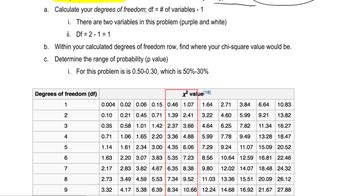
What is the significance of the Chi-square critical values table?
It provides threshold values to determine if Χ2 results are significant at various p-values and degrees of freedom.
How can Chi-square tests be used to test independent assortment?
By comparing observed offspring phenotypes from dihybrid crosses to expected ratios assuming independent gene segregation.
What is the expected phenotypic ratio for a dihybrid cross with independent assortment?
The classic Mendelian ratio is 9:3:3:1 for two traits.
What is the effect of linked genes on Chi-square tests for independent assortment?
Linked genes deviate from expected 9:3:3:1 ratios, leading to significant Chi-square values and rejection of independent assortment.
How does environment influence polygenic traits?
Environmental factors can modify the expression of polygenic traits, causing phenotypic variation beyond genetic effects.
What is an example of a non-additive polygenic trait?
ABO blood types, where the number of dominant alleles does not produce a continuous phenotype.
How do you interpret a Chi-square value of 0.52 with 3 degrees of freedom?
It indicates a good fit to the null hypothesis; observed data do not significantly differ from expected.
 뒤로뒤로
 00:53