 뒤로
Genetics: Linked Genes and Recombination Mapping
 11:11

이 집합의 용어 (20)
Genetic linkage occurs when two genes are located close together on the same chromosome and tend to be inherited together.
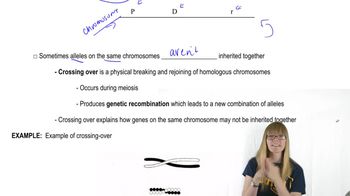
Crossing-over during Prophase I of meiosis causes recombination between linked genes by exchanging chromosome segments.
Recombination frequency = (Number of recombinant offspring / Total offspring) × 100%
1 mu or cM equals 1% recombination frequency between two genes, representing their genetic distance.
The maximum recombination frequency is 50%, which indicates independent assortment or genes behaving as if on different chromosomes.
A two-point cross is used to determine the genetic distance between two linked genes by analyzing offspring phenotypes.
Coupling means two dominant or two recessive alleles are on the same chromosome; repulsion means dominant and recessive alleles are on the same chromosome.
Because multiple crossovers can occur between distant genes, some recombination events go undetected, causing underestimation.
Interference is when a crossover event in one chromosome region reduces the probability of another crossover nearby.
A three-point cross maps the order and distances between three linked genes by analyzing single and double crossover offspring.
Compare double crossover (DCO) offspring to non-crossover (NCO) offspring; the gene that differs is the middle gene.
NCO: Non-crossover offspring; SCO: Single crossover offspring; DCO: Double crossover offspring.
Add the number of single and double crossovers between the two genes, divide by total offspring, and multiply by 100%.
Males are hemizygous for X-linked genes and do not undergo recombination, simplifying inheritance patterns.
Recombination frequency generally increases with physical distance but can underestimate actual physical distance due to multiple crossovers.
For unlinked genes, offspring genotypes appear in a 1:1:1:1 ratio due to independent assortment.
Recombination produces new allele combinations by exchanging chromosome segments, increasing genetic diversity.
Chiasmata are physical sites where crossing-over occurs between homologous chromosomes during Prophase I.
Identify the most frequent offspring genotypes as parental types to infer the parental chromosome arrangement.
It helps determine gene order and distances on chromosomes, aiding in understanding inheritance and gene function.