 뒤로
Genetics: Mutations and DNA Repair

 03:49

이 집합의 용어 (19)
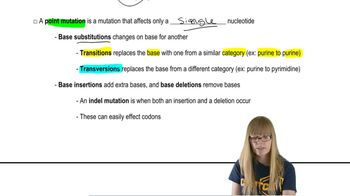
Point mutations are single base-pair substitutions, deletions, or insertions. Types include missense (amino acid change), nonsense (stop codon introduced), and silent (no amino acid change).
Transitions are purine-to-purine or pyrimidine-to-pyrimidine substitutions (e.g., A:T to G:C). Transversions are purine-to-pyrimidine or vice versa (e.g., A:T to T:A).
Somatic mutations occur in non-germ cells and are not heritable. Germ-line mutations occur in gametes and are inherited by offspring.
Spontaneous mutations arise from replication slippage, tautomeric shifts, DNA base damage (deamination, depurination), oxidative damage, and transposable elements.
During replication, loops in the template strand cause DNA polymerase to miss nucleotides, leading to small insertions or deletions, often in repeat sequences, causing frameshifts.
Tautomeric shifts are reversible changes in proton location in bases, creating tautomers that mispair during replication, increasing mutation rates.
Depurination is loss of a purine base, creating an apurinic site. Deamination converts an amino group to a keto group, changing base pairing properties and causing mutations.
Mutagens are agents causing mutations, including chemicals (base analogs, intercalating agents), UV light, and ionizing radiation (X-rays, gamma rays).
UV light induces pyrimidine dimers (e.g., thymine dimers) that distort DNA and can cause replication errors if unrepaired.
Base analogs mimic natural bases and cause mispairing. Intercalating agents insert between DNA bases, causing insertions or deletions (frameshifts).
Alkylating agents add alkyl groups to DNA bases, causing transitions, chromosomal aberrations, and strand breaks.
Ionizing radiation creates free radicals that damage bases, break phosphodiester bonds, and cause deletions, translocations, and fragmentation.
DNA repair systems include base excision repair (BER) for small lesions, nucleotide excision repair (NER) for bulky lesions, mismatch repair (MMR), homologous recombination (HR), and non-homologous end joining (NHEJ) for double-strand breaks.
MMR detects mismatches, creates a nick, degrades the error strand, inserts correct nucleotides, and ligates the nick to restore DNA integrity.
BER removes damaged bases via DNA glycosylase, cuts backbone with endonuclease, fills gap with DNA polymerase, and seals with DNA ligase.
NER removes bulky lesions like thymine dimers by excising an oligonucleotide fragment, filling the gap with DNA polymerase, and sealing with ligase; active in G1 phase.
Xeroderma pigmentosum is caused by NER defects, leading to extreme UV sensitivity, skin cancers, and neurological issues.
NHEJ ligates broken DNA ends directly and is error-prone. HR uses a sister chromatid as a template for accurate repair and is less error-prone.
DNA repair maintains genetic integrity, prevents mutations, and is crucial for survival by minimizing genetic damage accumulation.