 뒤로
Genomic Analysis and the Human Genome Project
 02:48

이 집합의 용어 (23)
Genomics is the study of genomes, involving sequencing, assembling, and analyzing genomes using recombinant DNA, DNA sequencing, and bioinformatics.
Fred Sanger and colleagues launched genomic analysis in 1977 by sequencing the 5400-nucleotide DNA genome of the ΦX174 virus.
1) Identifying spontaneous or induced mutations. 2) Generating linkage maps using mutant strains.
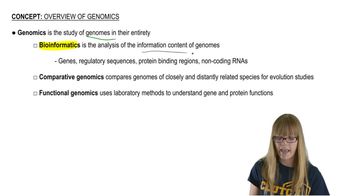
Structural genomics focuses on sequencing genomes and identifying genes. Functional genomics studies gene functions and regulatory elements.
To categorize all human genes, analyze genetic variation, develop new sequencing technologies, and share genome information publicly.
The HGP used hierarchical shotgun sequencing, involving cloning large DNA fragments into bacterial artificial chromosomes (BACs) before sequencing.
Celera used direct whole genome shotgun sequencing, sequencing random DNA fragments directly without cloning into BACs.
Randomly break the genome into small fragments, sequence them, then use computer programs to find overlaps and reassemble the genome.
Splitting the genome into large fragments (150-350 kbp), cloning into BACs, mapping BACs, then sequencing smaller fragments from BACs.
To identify unique restriction enzyme fragment patterns for each BAC, enabling their correct order assembly into a genomic scaffold.
A selected subset of BACs with minimal overlap that covers the entire genome for efficient sequencing.
It is faster and cheaper but computationally expensive and error-prone due to repetitive sequences.
Only about 2% of the human genome consists of protein-coding sequences.
At least 50% of the human genome is derived from transposable elements like LINEs and Alu sequences.
About 20,000 protein-coding genes, fewer than previously estimated.
Computer-based approaches to organize, share, and analyze gene structure, sequence, expression, and protein function data.
A large public database maintained by NCBI that stores DNA sequences, each with a unique accession number for retrieval.
The process of identifying genes, regulatory sequences, and their functions within a genome sequence.
BLAST (Basic Local Alignment Search Tool) compares a DNA sequence to database sequences to find similarities and identify genes.
Identity value is the percentage of identical matches; E value estimates the likelihood the match occurred by chance (lower is better).
Analyzing nucleotide sequences to identify genes and regulatory elements based on common features like promoters and exons.
Studying gene functions based on RNA and protein products and regulatory elements, often confirming computational predictions experimentally.
Identification of disease genes and development of new treatment strategies through extensive gene mapping.