
As part of a cancer research project, you have discovered a gene that is mutated in many metastatic tumors. After determining the DNA sequence of this gene, you compare the sequence with those of other genes in the human genome sequence database. Your gene appears to code for an amino acid sequence that resembles sequences found in some serine proteases. Conjecture how your new gene might contribute to the development of highly invasive cancers.
Ch. 19 - The Genetics of Cancer
19장, 문제 27
Those who inherit a mutant allele of the RB1 tumor-suppressor gene are at risk for developing a bone cancer called osteosarcoma. You suspect that in these cases, osteosarcoma requires a mutation in the second RB1 allele, and you have cultured some osteosarcoma cells and obtained a cDNA clone of a normal human RB1 gene. A colleague sends you a research paper revealing that a strain of cancer-prone mice develops malignant tumors when injected with osteosarcoma cells, and you obtain these mice. Using these three resources, what experiments would you perform to determine:
(a) Whether osteosarcoma cells carry two RB1 mutations
(b) Whether osteosarcoma cells produce any pRB protein
(c) If the addition of a normal RB1 gene will change the cancer-causing potential of osteosarcoma cells?
검증된 단계별 안내1
For part (a), to determine whether osteosarcoma cells carry two RB1 mutations, start by isolating genomic DNA from the osteosarcoma cells. Then, perform PCR amplification of the RB1 gene regions followed by DNA sequencing. Compare the sequences to the normal RB1 gene sequence to identify mutations in both alleles. Alternatively, use techniques like Southern blotting or allele-specific PCR to detect deletions or mutations in each allele.
For part (b), to check whether osteosarcoma cells produce any pRB protein, extract total protein from the cells and perform a Western blot analysis using an antibody specific to the pRB protein. This will reveal the presence or absence of pRB and can also indicate if the protein is truncated or altered in size, suggesting a mutation affecting protein expression or stability.
For part (c), to test if adding a normal RB1 gene changes the cancer-causing potential of osteosarcoma cells, transfect the osteosarcoma cells with the normal human RB1 cDNA clone. Then, inject these transfected cells into the cancer-prone mice and monitor tumor development compared to mice injected with untransfected osteosarcoma cells. A reduction in tumor formation would suggest that the normal RB1 gene suppresses the cancer phenotype.
Throughout these experiments, include proper controls such as cells known to have normal RB1 alleles and cells lacking RB1 function to validate your assays and interpretations.
Finally, analyze and interpret the data to understand the role of RB1 mutations and pRB protein expression in osteosarcoma development and progression, and how restoring normal RB1 function might impact tumorigenicity.

비슷한 문제에 대한 검증된 영상 답변:
이 영상 해법은 위 문제에 도움이 된다고 튜터들이 추천한 것입니다.
영상 길이:
1m주요 개념
질문에 올바르게 답하기 위해 반드시 이해해야 하는 핵심 개념들은 다음과 같습니다.
Tumor Suppressor Genes and the Two-Hit Hypothesis
Tumor suppressor genes like RB1 help regulate cell growth and prevent cancer. The two-hit hypothesis states that both alleles of such a gene must be inactivated by mutations for cancer to develop. Understanding this concept is crucial to investigate whether osteosarcoma cells have mutations in both RB1 alleles.
추천 영상:
가이드 코스
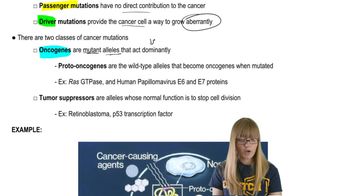
Cancer Mutations
Gene Expression and Protein Production Analysis
Determining if osteosarcoma cells produce pRB protein involves analyzing gene expression at the mRNA and protein levels. Techniques like Western blotting or immunostaining detect pRB protein presence, while RT-PCR can assess RB1 mRNA, helping to understand functional consequences of mutations.
추천 영상:
가이드 코스
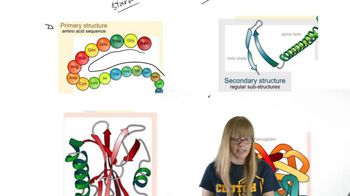
Proteins
Functional Complementation and Tumorigenicity Assays
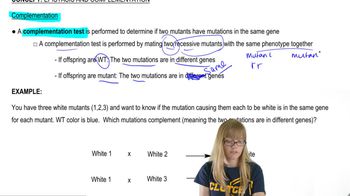
Introducing a normal RB1 gene into cancer cells tests if restoring pRB function reduces tumorigenic potential. Functional complementation assays combined with in vivo tumorigenicity tests in cancer-prone mice reveal whether the normal gene suppresses cancer growth, demonstrating the gene's role in tumor suppression.
추천 영상:
가이드 코스
Complementation
관련 실천
교과서 질문
560
views
교과서 질문
A study by Bose and colleagues (1998). Blood 92:3362-3367] and a previous study by Biernaux and others (1996). Bone Marrow Transplant 17:(Suppl. 3) S45–S47] showed that BCR-ABL fusion gene transcripts can be detected in 25 to 30 percent of healthy adults who do not develop chronic myelogenous leukemia (CML). Explain how these individuals can carry a fusion gene that is transcriptionally active and yet does not develop CML.
500
views
