Ch. 2 - Mitosis and Meiosis
Klug - Essentials of Genetics 10th Edition
Klug10th EditionEssentials of GeneticsISBN: 9780135588789당신이 사용하는 게 아니라요?교과서 변경
2장, 문제 15

A diploid cell contains three pairs of homologous chromosomes designated C1 and C2, M1 and M2, and S1 and S2. No crossing over occurs. What combinations of chromosomes are possible in?
(a) daughter cells following mitosis
(b) cells undergoing the first meiotic metaphase
(c) haploid cells following both divisions of meiosis

검증된 단계별 안내
1
Step 1: Understand the chromosome setup. The diploid cell has three pairs of homologous chromosomes: C1 and C2, M1 and M2, S1 and S2. Since no crossing over occurs, each chromosome remains intact and does not exchange segments with its homologous partner.
Step 2: For part (a), mitosis produces two daughter cells that are genetically identical to the parent cell. Each daughter cell receives one copy of each chromosome from each homologous pair. Therefore, the possible chromosome combinations in each daughter cell are exactly the same as the original diploid cell: C1 and C2, M1 and M2, S1 and S2.
Step 3: For part (b), during the first meiotic metaphase, homologous chromosomes pair up and align at the metaphase plate. The possible combinations here involve the arrangement of homologous pairs (C1 with C2, M1 with M2, S1 with S2) side by side. Since no crossing over occurs, the chromosomes remain intact, but their orientation can vary, which affects the combinations in the resulting cells.
Step 4: For part (c), after both meiotic divisions, haploid cells are formed. Each haploid cell contains one chromosome from each homologous pair. Because no crossing over occurs, the chromosomes are inherited as whole units. The possible combinations are all the different ways to inherit one chromosome from each pair (either C1 or C2, M1 or M2, S1 or S2).
Step 5: To summarize the combinations mathematically, use the formula for independent assortment: the number of possible combinations is \$2^n$, where $n$ is the number of chromosome pairs. Here, $n=3$, so the number of possible combinations in haploid cells after meiosis is \$2^3$. This reflects the different ways chromosomes can assort into gametes.

비슷한 문제에 대한 검증된 영상 답변:

이 영상 해법은 위 문제에 도움이 된다고 튜터들이 추천한 것입니다.
영상 길이:
3m

주요 개념

질문에 올바르게 답하기 위해 반드시 이해해야 하는 핵심 개념들은 다음과 같습니다.

Mitosis and Chromosome Segregation

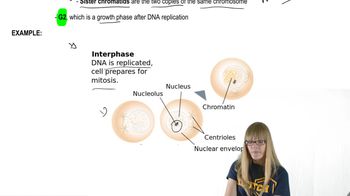
Mitosis is a type of cell division that results in two genetically identical daughter cells, each with the same number of chromosomes as the original diploid cell. Homologous chromosomes do not pair or segregate separately; instead, sister chromatids separate, ensuring each daughter cell receives one copy of each chromosome.
추천 영상:

Meiosis I and Homologous Chromosome Pairing

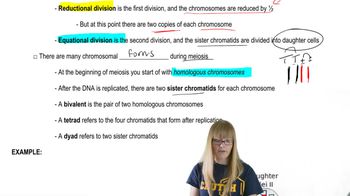
During the first meiotic division, homologous chromosomes pair up and align at the metaphase plate. This pairing allows for the segregation of homologous chromosomes into two daughter cells, reducing the chromosome number by half. Since no crossing over occurs, chromosomes segregate as intact units.
추천 영상:
가이드 코스
05:30
Meiosis Overview

Haploid Cells after Meiosis II

Meiosis II resembles mitosis, where sister chromatids separate into individual chromosomes. After both meiotic divisions, the resulting haploid cells contain one chromosome from each homologous pair, representing all possible combinations of the original chromosomes without recombination.
추천 영상:
가이드 코스
05:30
Meiosis Overview