Describe the origin of cultivated American cotton.
Ch. 6 - Chromosome Mutations: Variation in Number and Arrangement
6장, 문제 9
Predict how the synaptic configurations of homologous pairs of chromosomes might appear when one member is normal and the other member has sustained a deletion or duplication.
검증된 단계별 안내1
Understand that synapsis is the pairing of homologous chromosomes during prophase I of meiosis, where chromosomes align gene by gene to form a synaptonemal complex.
Recognize that when one homologous chromosome has a deletion (a missing segment), the other homologous chromosome will have an unpaired region because there is no corresponding segment to pair with.
Predict that the chromosome with the deletion will cause a loop or bulge to form on the normal chromosome during synapsis, as the normal chromosome's extra segment has no counterpart on the deleted chromosome.
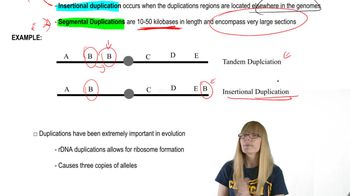
Similarly, if one homolog has a duplication (an extra segment), the duplicated region will loop out on the chromosome with the duplication to allow the rest of the chromosome to align properly with the normal homolog.
Conclude that these loops or bulges are visible under a microscope during meiosis and represent structural adjustments to maintain as much pairing as possible despite the deletion or duplication.

비슷한 문제에 대한 검증된 영상 답변:
이 영상 해법은 위 문제에 도움이 된다고 튜터들이 추천한 것입니다.
영상 길이:
2m주요 개념
질문에 올바르게 답하기 위해 반드시 이해해야 하는 핵심 개념들은 다음과 같습니다.
Chromosome Synapsis
Synapsis is the pairing of homologous chromosomes during prophase I of meiosis, allowing for alignment and recombination. Proper synapsis ensures that homologs are closely paired along their lengths, facilitating genetic exchange and accurate segregation.
추천 영상:
가이드 코스
Chromosome Structure
Chromosomal Deletions and Duplications
Deletions involve the loss of a chromosome segment, while duplications involve the repetition of a segment. These structural changes alter the length and gene content of one homolog, potentially disrupting normal pairing during meiosis.
추천 영상:
가이드 코스
Duplications
Synaptic Configurations in Structural Heterozygotes
When one homolog has a deletion or duplication, synapsis can form loops or unpaired regions to accommodate length differences. For example, a duplication may cause a loop on the normal chromosome, while a deletion may cause a loop on the altered chromosome, reflecting misalignment.
추천 영상:
가이드 코스
Ribosome Structure
관련 실천
교과서 질문
795
views
교과서 질문
Inversions are said to 'suppress crossing over.' Is this terminology technically correct? If not, restate the description accurately.
682
views
교과서 질문
Contrast the fertility of an allotetraploid with an autotriploid and an autotetraploid.
810
views
교과서 질문
Human adult hemoglobin is a tetramer containing two alpha (α) and two beta (β) polypeptide chains. The α gene cluster on chromosome 16 and the β gene cluster on chromosome 11 share amino acid similarities such that 61 of the amino acids of the α-globin polypeptide (141 amino acids long) are shared in identical sequence with the β-globin polypeptide (146 amino acids long). How might one explain the existence of two polypeptides with partially shared function and structure on two different chromosomes?
568
views