Ch. 15 - Gene Mutation, DNA Repair, and Transposition
Klug - Concepts of Genetics 12th Edition
Klug12th EditionConcepts of GeneticsISBN: 9780135564776당신이 사용하는 게 아니라요?교과서 변경
15장, 문제 14

Contrast the various types of DNA repair mechanisms known to counteract the effects of UV radiation. What is the role of visible light in repairing UV-induced mutations?

검증된 단계별 안내
1
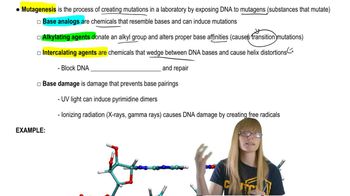
Begin by identifying the main types of DNA damage caused by UV radiation, such as the formation of thymine dimers, which distort the DNA helix and block replication.
Describe the different DNA repair mechanisms that cells use to fix UV-induced damage, including nucleotide excision repair (NER), base excision repair (BER), and direct repair mechanisms like photoreactivation.
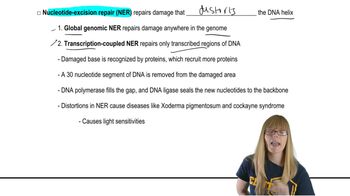
Explain nucleotide excision repair (NER) in detail: how it recognizes bulky lesions like thymine dimers, excises a short single-stranded DNA segment containing the damage, and fills in the gap using DNA polymerase and ligase.
Discuss photoreactivation, a direct repair mechanism where the enzyme photolyase uses energy from visible light to break the bonds of thymine dimers, restoring the original DNA structure without excision.
Clarify the specific role of visible light in photoreactivation: it activates photolyase, enabling it to reverse UV-induced thymine dimers efficiently, which is a unique repair pathway dependent on light energy.

비슷한 문제에 대한 검증된 영상 답변:

이 영상 해법은 위 문제에 도움이 된다고 튜터들이 추천한 것입니다.
영상 길이:
2m

주요 개념

질문에 올바르게 답하기 위해 반드시 이해해야 하는 핵심 개념들은 다음과 같습니다.

Types of DNA Repair Mechanisms

DNA repair mechanisms are cellular processes that correct damage to DNA molecules. Key types include direct repair, excision repair (base excision and nucleotide excision), mismatch repair, and recombinational repair. Each mechanism targets specific types of damage to maintain genomic integrity.
추천 영상:
가이드 코스
05:44
Repair Pathways

UV-Induced DNA Damage

Ultraviolet (UV) radiation primarily causes DNA damage by inducing the formation of pyrimidine dimers, such as thymine dimers, which distort the DNA helix and block replication. Understanding this damage is essential to grasp why specific repair pathways are activated.
추천 영상:
가이드 코스
04:29
Induced Mutations

Role of Visible Light in Photoreactivation

Visible light drives photoreactivation, a direct repair process where the enzyme photolyase absorbs light energy to break the bonds of UV-induced pyrimidine dimers. This light-dependent repair reverses mutations without excision, highlighting the unique role of visible light in DNA repair.
추천 영상: