Ch. 17 - Transcriptional Regulation in Eukaryotes
Klug - Concepts of Genetics 12th Edition
Klug12th EditionConcepts of GeneticsISBN: 9780135564776당신이 사용하는 게 아니라요?교과서 변경
17장, 문제 6

A number of experiments have demonstrated that areas of the genome that are transcriptionally inactive are also resistant to DNase I digestion. However, transcriptionally active areas are DNase I sensitive. Describe how DNase I resistance or sensitivity might indicate transcriptional activity.

검증된 단계별 안내
1
Understand that DNase I is an enzyme that cuts DNA, but it can only access DNA that is not tightly packed or protected by proteins.
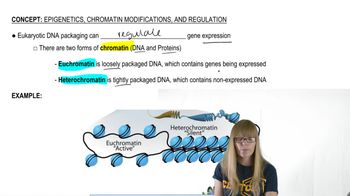
Recognize that transcriptionally active regions of the genome are usually in an open chromatin state, meaning the DNA is loosely packed and accessible to enzymes like DNase I.
Know that transcriptionally inactive regions are often tightly packed into heterochromatin, making the DNA less accessible and therefore resistant to DNase I digestion.
Interpret DNase I sensitivity as an indicator that the chromatin is open and the DNA is accessible, which correlates with active transcription because the transcription machinery can access the DNA.
Conclude that DNase I resistance suggests the chromatin is closed or condensed, preventing transcription factors and RNA polymerase from accessing the DNA, thus indicating transcriptional inactivity.

비슷한 문제에 대한 검증된 영상 답변:

이 영상 해법은 위 문제에 도움이 된다고 튜터들이 추천한 것입니다.
영상 길이:
3m

주요 개념

질문에 올바르게 답하기 위해 반드시 이해해야 하는 핵심 개념들은 다음과 같습니다.

Chromatin Structure and Accessibility

Chromatin exists in two main forms: euchromatin (loosely packed) and heterochromatin (tightly packed). Transcriptionally active regions are usually euchromatic, making DNA more accessible to enzymes like DNase I. In contrast, inactive regions are heterochromatic and less accessible, leading to DNase I resistance.
추천 영상:

DNase I Hypersensitivity Assay

DNase I is an enzyme that cleaves DNA where it is exposed and not tightly bound by proteins. Regions sensitive to DNase I digestion indicate open chromatin and active transcription, while resistant regions suggest closed chromatin and transcriptional inactivity. This assay helps map regulatory elements.
추천 영상:
가이드 코스
03:44
Plaques and Experiments

Transcriptional Regulation and DNA-Protein Interactions

Transcription factors and other regulatory proteins bind to DNA in active regions, altering chromatin structure to facilitate transcription. These interactions open the chromatin, increasing DNase I sensitivity. Conversely, inactive regions lack such interactions, maintaining a compact structure resistant to DNase I.
추천 영상: