Ch. 2 - Mitosis and Meiosis
Klug - Concepts of Genetics 12th Edition
Klug12th EditionConcepts of GeneticsISBN: 9780135564776당신이 사용하는 게 아니라요?교과서 변경
2장, 문제 13

Contrast spermatogenesis and oogenesis. What is the significance of the formation of polar bodies?

검증된 단계별 안내
1
Begin by defining spermatogenesis and oogenesis as the processes of male and female gamete formation, respectively, highlighting that both occur through meiosis but have distinct outcomes.
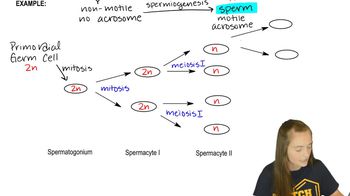
Explain spermatogenesis as a continuous process producing four viable sperm cells from each primary spermatocyte, emphasizing equal cytokinesis and the goal of producing motile gametes.
Describe oogenesis as an intermittent process resulting in one large ovum and smaller polar bodies due to unequal cytokinesis, which conserves cytoplasm in the ovum.
Discuss the formation of polar bodies as a mechanism to discard extra haploid sets of chromosomes while preserving most of the cytoplasm in the single ovum, which is crucial for early embryonic development.
Summarize the significance of polar bodies in ensuring that the ovum has sufficient nutrients and organelles to support the embryo, contrasting this with the production of multiple sperm cells optimized for mobility.

비슷한 문제에 대한 검증된 영상 답변:

이 영상 해법은 위 문제에 도움이 된다고 튜터들이 추천한 것입니다.
영상 길이:
3m

주요 개념

질문에 올바르게 답하기 위해 반드시 이해해야 하는 핵심 개념들은 다음과 같습니다.

Spermatogenesis

Spermatogenesis is the process by which male gametes, or sperm cells, are produced in the testes. It involves a series of mitotic and meiotic divisions resulting in four haploid sperm cells from each primary spermatocyte, ensuring genetic diversity and continuous sperm production.
추천 영상:
가이드 코스
21:21
Gamete Development

Oogenesis

Oogenesis is the formation of female gametes, or ova, in the ovaries. Unlike spermatogenesis, it produces one viable egg and smaller polar bodies through unequal cytokinesis during meiosis, conserving cytoplasm in the egg to support early embryonic development.
추천 영상:
가이드 코스
21:21
Gamete Development

Formation and Significance of Polar Bodies

Polar bodies are small cells produced during oogenesis that contain excess genetic material but minimal cytoplasm. Their formation allows the egg to retain most of the cytoplasm, which is crucial for nourishing the embryo after fertilization, while discarding extra chromosomes to maintain haploidy.
추천 영상:
가이드 코스
04:06
Formation of Plant Gametes