Ch. 11 - Gene Mutation, DNA Repair, and Homologous Recombination
Sanders - Genetic Analysis: An Integrated Approach 3rd Edition
Sanders3rd EditionGenetic Analysis: An Integrated ApproachISBN: 9780135564172당신이 사용하는 게 아니라요?교과서 변경
11장, 문제 29c

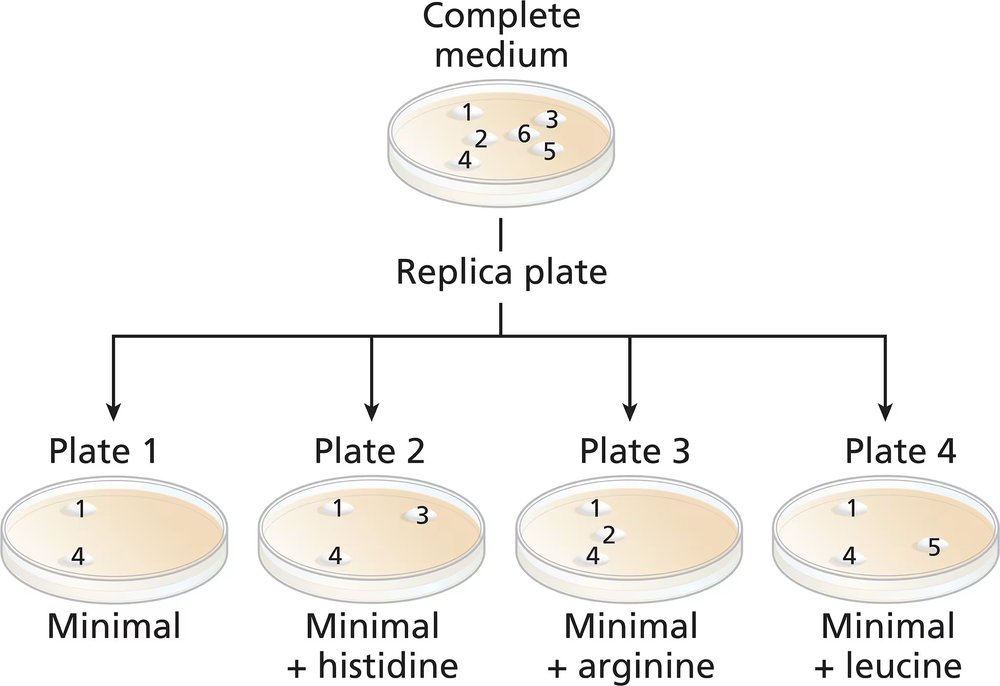
A wild-type culture of haploid yeast is exposed to ethyl methanesulfonate (EMS). Yeast cells are plated on a complete medium, and 6 colonies (colonies numbered 1 to 6) are transferred to a new complete medium plate for further study. Four replica plates are made from the complete medium plate to plates containing minimal medium or minimal medium plus one amino acid (replica plates numbered 1 to 4) with the following results:
Diagram showing yeast colonies on a complete medium plate and their transfer to replica plates with minimal media variations.
Identify any colonies that are his⁻, arg⁻, leu⁻.

검증된 단계별 안내
1
Step 1: Understand the experimental setup. The yeast cells are haploid, meaning they have only one copy of each gene. Ethyl methanesulfonate (EMS) is a mutagen that induces random mutations in the DNA. The goal is to identify colonies with specific auxotrophic mutations (his⁻, arg⁻, leu⁻), which means they cannot synthesize histidine, arginine, or leucine, respectively, and require these amino acids to grow.
Step 2: Analyze the replica plating results. Replica plating involves transferring colonies from a master plate to plates with different growth conditions. In this case, there are four plates: (1) minimal medium (MM), (2) MM + histidine, (3) MM + arginine, and (4) MM + leucine. Colonies that fail to grow on MM but grow on MM supplemented with a specific amino acid indicate a mutation in the corresponding biosynthetic pathway.
Step 3: Compare the growth patterns of each colony across the replica plates. For each colony (1 to 6), check whether it grows on MM. If it does not grow on MM but grows on MM + histidine, it is his⁻. Similarly, if it grows only on MM + arginine, it is arg⁻, and if it grows only on MM + leucine, it is leu⁻.
Step 4: Record the results for each colony. Based on the growth patterns, assign the appropriate auxotrophic designation (his⁻, arg⁻, leu⁻) to each colony. Colonies that grow on MM are prototrophic (wild-type) and do not require supplementation.
Step 5: Summarize the findings. List the colonies that are his⁻, arg⁻, and leu⁻ based on their growth requirements. This information will help identify the specific mutations induced by EMS in the yeast cells.

비슷한 문제에 대한 검증된 영상 답변:

이 영상 해법은 위 문제에 도움이 된다고 튜터들이 추천한 것입니다.
영상 길이:
4m

주요 개념

질문에 올바르게 답하기 위해 반드시 이해해야 하는 핵심 개념들은 다음과 같습니다.

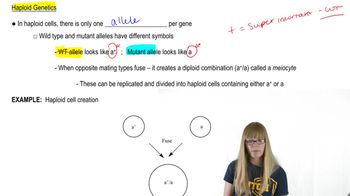
Haploid Organisms

Haploid organisms, like yeast, have a single set of chromosomes, which means they carry only one allele for each gene. This simplifies genetic analysis because any mutation will directly manifest in the phenotype. In the context of the question, identifying mutations in haploid yeast allows researchers to easily determine the effects of specific genetic changes, such as those induced by EMS.
추천 영상:
가이드 코스
02:45
Haploid Genetics

Mutagenesis

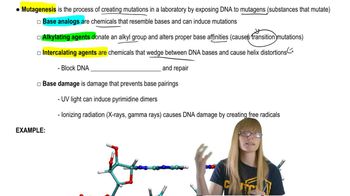
Mutagenesis is the process by which the genetic information of an organism is changed, resulting in mutations. Ethyl methanesulfonate (EMS) is a chemical mutagen that can induce point mutations, leading to changes in amino acid sequences of proteins. Understanding mutagenesis is crucial for interpreting the results of the yeast colonies, as it helps explain the potential loss of function in genes related to histidine (his), arginine (arg), and leucine (leu) biosynthesis.
추천 영상:
가이드 코스
04:29
Induced Mutations

Amino Acid Auxotrophy

Amino acid auxotrophy occurs when an organism cannot synthesize a particular amino acid and thus requires it to be supplied in the growth medium. In the experiment, colonies that are his⁻, arg⁻, or leu⁻ cannot grow on minimal medium unless the corresponding amino acid is added. Identifying these auxotrophic mutants is essential for understanding the genetic basis of metabolic pathways and the effects of mutations induced by EMS.
추천 영상:
관련 실천
교과서 질문

A wild-type culture of haploid yeast is exposed to ethyl methanesulfonate (EMS). Yeast cells are plated on a complete medium, and 6 colonies (colonies numbered 1 to 6) are transferred to a new complete medium plate for further study. Four replica plates are made from the complete medium plate to plates containing minimal medium or minimal medium plus one amino acid (replica plates numbered 1 to 4) with the following results:

Identify the colonies that are prototrophic (wild type). What growth information leads to your answer? 

441
views
교과서 질문

A wild-type culture of haploid yeast is exposed to ethyl methanesulfonate (EMS). Yeast cells are plated on a complete medium, and 6 colonies (colonies numbered 1 to 6) are transferred to a new complete medium plate for further study. Four replica plates are made from the complete medium plate to plates containing minimal medium or minimal medium plus one amino acid (replica plates numbered 1 to 4) with the following results:

For colonies 1, 3, and 5, write '+' for the wild-type synthesis and '−' for the mutant synthesis of histidine and leucine.

505
views
교과서 질문

A fragment of a wild-type polypeptide is sequenced for seven amino acids. The same polypeptide region is sequenced in four mutants.

Use the available information to characterize each mutant.

524
views
교과서 질문

In an Ames test using his⁻ Salmonella bacteria a researcher determines that adding a test compound plus the S9 extract produces a large number of his⁺ revertants but mixing the his⁻ strain plus the test compound without adding S9 does not produce an elevated number of his⁺ revertants.

Is the test compound still considered to be a potential mutagen? Explain why or why not.

473
views
교과서 질문

A wild-type culture of haploid yeast is exposed to ethyl methanesulfonate (EMS). Yeast cells are plated on a complete medium, and 6 colonies (colonies numbered 1 to 6) are transferred to a new complete medium plate for further study. Four replica plates are made from the complete medium plate to plates containing minimal medium or minimal medium plus one amino acid (replica plates numbered 1 to 4) with the following results:

Are there any colonies for which genotype information cannot be determined? If so, which colony or colonies?

574
views
교과서 질문

A wild-type culture of haploid yeast is exposed to ethyl methanesulfonate (EMS). Yeast cells are plated on a complete medium, and 6 colonies (colonies numbered 1 to 6) are transferred to a new complete medium plate for further study. Four replica plates are made from the complete medium plate to plates containing minimal medium or minimal medium plus one amino acid (replica plates numbered 1 to 4) with the following results:

Identify the colonies that are auxotrophic (mutant). What growth information leads to your answer? 

556
views