Ch. 11 - Gene Mutation, DNA Repair, and Homologous Recombination
Sanders - Genetic Analysis: An Integrated Approach 3rd Edition
Sanders3rd EditionGenetic Analysis: An Integrated ApproachISBN: 9780135564172당신이 사용하는 게 아니라요?교과서 변경
11장, 문제 20a

The partial amino acid sequence of a wild-type protein is
… Arg-Met-Tyr-Thr-Leu-Cys-Ser …
The same portion of the protein from a mutant has the sequence
… Arg-Met-Leu-Tyr-Ala-Leu-Phe …
Identify the type of mutation.

검증된 단계별 안내
1
Compare the amino acid sequences of the wild-type and mutant proteins to identify the differences. Note that the wild-type sequence is Arg-Met-Tyr-Thr-Leu-Cys-Ser, while the mutant sequence is Arg-Met-Leu-Tyr-Ala-Leu-Phe.
Determine the codons that correspond to the amino acids in the wild-type sequence and the mutant sequence. Use the genetic code table to map each amino acid to its possible codons.
Identify the specific changes in the codons that could lead to the observed differences in the amino acid sequence. For example, determine which nucleotide substitutions, insertions, or deletions could explain the changes in the amino acids.
Classify the type of mutation based on the observed changes. For example, if a single nucleotide substitution changes one amino acid to another, it is a missense mutation. If the reading frame is altered, it is a frameshift mutation.
Conclude the type of mutation by analyzing whether the changes are consistent with a point mutation, frameshift mutation, or another type of mutation, and explain how the mutation affects the protein sequence.

비슷한 문제에 대한 검증된 영상 답변:

이 영상 해법은 위 문제에 도움이 된다고 튜터들이 추천한 것입니다.
영상 길이:
1m

주요 개념

질문에 올바르게 답하기 위해 반드시 이해해야 하는 핵심 개념들은 다음과 같습니다.

Types of Mutations

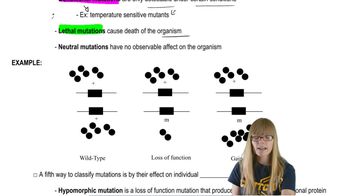
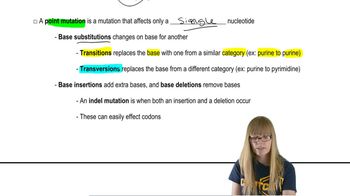
Mutations can be classified into several types, including point mutations, insertions, deletions, and frameshift mutations. Point mutations involve a change in a single nucleotide, which can lead to missense, nonsense, or silent mutations. Insertions and deletions involve the addition or loss of nucleotides, potentially altering the reading frame of the gene.
추천 영상:
가이드 코스
10:48
Mutations and Phenotypes

Missense Mutation

A missense mutation occurs when a single nucleotide change results in the substitution of one amino acid for another in the protein sequence. This can affect the protein's function depending on the properties of the substituted amino acid and its role in the protein's structure or activity.
추천 영상:
가이드 코스
09:49
Point Mutations

Amino Acid Sequence

The amino acid sequence of a protein is determined by the sequence of nucleotides in the corresponding gene. Each set of three nucleotides, known as a codon, codes for a specific amino acid. Changes in the nucleotide sequence can lead to alterations in the amino acid sequence, which may impact the protein's function and stability.
추천 영상:
가이드 코스
08:41
Sequencing Difficulties
관련 실천
교과서 질문

Using the adenine–thymine base pair in this DNA sequence

...GCTC...

...CGAG...

Give the sequence after a transition mutation.

614
views
교과서 질문

The partial amino acid sequence of a wild-type protein is

… Arg-Met-Tyr-Thr-Leu-Cys-Ser …

The same portion of the protein from a mutant has the sequence

… Arg-Met-Leu-Tyr-Ala-Leu-Phe …

Give the sequence of the wild-type DNA template strand. Use A/G if the nucleotide could be either purine, T/C if it could be either pyrimidine, N if any nucleotide could occur at a site, or the alternative nucleotides if a purine and a pyrimidine are possible.

604
views
교과서 질문

The two DNA and polypeptide sequences shown are for alleles at a hypothetical locus that produce different polypeptides, both five amino acids long. In each case, the lower DNA strand is the template strand:

Based on DNA and polypeptide sequences alone, is there any way to determine which allele is dominant and which is recessive? Why or why not?

591
views
교과서 질문

Many human genes are known to have homologs in the mouse genome. One approach to investigating human hereditary disease is to produce mutations of the mouse homologs of human genes by methods that can precisely target specific nucleotides for mutation.

Numerous studies of mutations of the mouse homologs of human genes have yielded valuable information about how gene mutations influence the human disease process. In general terms, describe how and why creating mutations of the mouse homologs can give information about human hereditary disease processes.

734
views
교과서 질문

How are flanking direct repeat sequences created by transposition?

766
views
교과서 질문

Using the adenine–thymine base pair in this DNA sequence

...GCTC...

...CGAG...

Give the sequence after a transversion mutation.

629
views