Ch. 12 - Regulation of Gene Expression in Bacteria and Bacteriophage
Sanders - Genetic Analysis: An Integrated Approach 3rd Edition
Sanders3rd EditionGenetic Analysis: An Integrated ApproachISBN: 9780135564172당신이 사용하는 게 아니라요?교과서 변경
12장, 문제 15

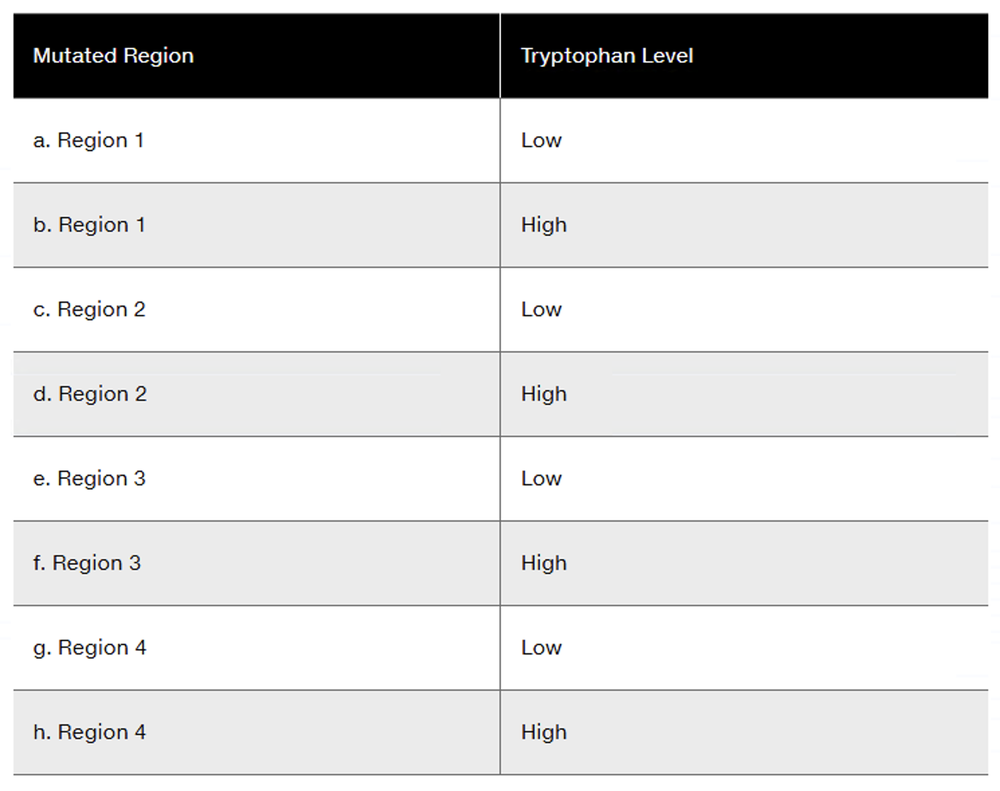
Attenuation of trp operon transcription is controlled by the formation of stem-loop structures in mRNA. The attenuation function can be disrupted by mutations that alter the sequence of repeat DNA regions 1 to 4 and prevent the formation of mRNA stem loops. Describe the likely effects on attenuation of each of the following mutations under the conditions specified.
Table showing mutated regions of the trp operon and their corresponding tryptophan levels.

검증된 단계별 안내
1
Understand the trp operon attenuation mechanism: The trp operon in bacteria is regulated by attenuation, which involves the formation of stem-loop structures in the leader mRNA. These structures depend on the interaction of regions 1, 2, 3, and 4 of the leader sequence. The formation of specific stem-loops determines whether transcription continues or terminates.
Analyze the role of each region: Region 1 interacts with region 2, and region 3 interacts with region 4. When tryptophan levels are low, ribosomes stall at region 1, allowing regions 2 and 3 to form an anti-terminator stem-loop, which permits transcription. When tryptophan levels are high, ribosomes do not stall, allowing regions 3 and 4 to form a terminator stem-loop, halting transcription.
Evaluate the effect of mutations in region 1: If region 1 is mutated, ribosome stalling may be disrupted. Under low tryptophan conditions, this could prevent the formation of the anti-terminator (regions 2-3), leading to premature termination. Under high tryptophan conditions, the terminator (regions 3-4) may still form, so transcription termination would likely proceed as usual.
Evaluate the effect of mutations in region 2: If region 2 is mutated, it may not pair with region 1 or region 3. Under low tryptophan conditions, the anti-terminator (regions 2-3) may fail to form, leading to premature termination. Under high tryptophan conditions, the terminator (regions 3-4) may still form, so transcription termination would likely proceed as usual.
Evaluate the effect of mutations in regions 3 and 4: If region 3 is mutated, it may not pair with region 2 or region 4. Under low tryptophan conditions, the anti-terminator (regions 2-3) may fail to form, leading to premature termination. Under high tryptophan conditions, the terminator (regions 3-4) may fail to form, allowing transcription to continue. If region 4 is mutated, the terminator (regions 3-4) cannot form under high tryptophan conditions, leading to continued transcription regardless of tryptophan levels.

비슷한 문제에 대한 검증된 영상 답변:

이 영상 해법은 위 문제에 도움이 된다고 튜터들이 추천한 것입니다.
영상 길이:
2m

주요 개념

질문에 올바르게 답하기 위해 반드시 이해해야 하는 핵심 개념들은 다음과 같습니다.

trp Operon and Attenuation

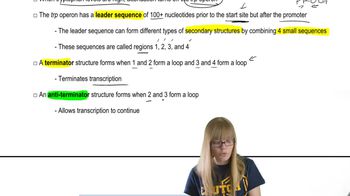
The trp operon is a group of genes in bacteria that are involved in the biosynthesis of tryptophan. Attenuation is a regulatory mechanism that controls the transcription of the trp operon based on tryptophan levels. It involves the formation of specific mRNA structures that can either promote or terminate transcription, depending on the availability of tryptophan.
추천 영상:
가이드 코스
09:11
Trp Attenuation

Stem-Loop Structures in mRNA

Stem-loop structures are secondary structures formed in RNA molecules, crucial for the regulation of gene expression. In the context of the trp operon, the formation of these structures in the mRNA can lead to either the continuation or termination of transcription. The specific arrangement of regions 1 to 4 in the mRNA determines whether a transcription termination signal is generated.
추천 영상:
가이드 코스
03:49
Ribosome Structure

Impact of Mutations on Transcription Regulation

Mutations in the DNA sequence of the trp operon can disrupt the formation of stem-loop structures, thereby affecting the attenuation process. Depending on the location and nature of the mutation, the ability of the mRNA to form the necessary structures will change, influencing whether transcription is terminated or allowed to proceed. This can lead to altered levels of tryptophan synthesis in response to varying tryptophan concentrations.
추천 영상:
가이드 코스
09:16
Eukaryotic Transcription