
Ch. 17 - Organelle Inheritance and the Evolution of Organelle Genomes
Sanders - Genetic Analysis: An Integrated Approach 3rd Edition
Sanders3rd EditionGenetic Analysis: An Integrated ApproachISBN: 9780135564172당신이 사용하는 게 아니라요?교과서 변경
17장, 문제 18

The following pedigree shows a family in which several individuals exhibit symptoms of the mitochondrial disease MERRF. Two siblings (II-2 and II-5) approach you to inquire about whether their children will also be afflicted with MERRF. What do you tell them? 
Pedigree chart showing family members with MERRF symptoms for genetics course.

검증된 단계별 안내
1
Analyze the pedigree chart: MERRF (Myoclonic Epilepsy with Ragged Red Fibers) is a mitochondrial disease, which means it is inherited through mitochondrial DNA. Mitochondrial DNA is passed exclusively from mother to offspring, as sperm do not contribute mitochondria during fertilization.
Identify affected individuals: In the pedigree, individuals with filled symbols (black circles or squares) exhibit symptoms of MERRF. Note that all affected individuals are descendants of the female in generation I-1, who is also affected.
Determine inheritance pattern: Since mitochondrial DNA is maternally inherited, only females can pass the disease to their offspring. Males, even if affected, cannot transmit the disease to their children.
Focus on II-2 and II-5: Individual II-2 is female and affected, meaning she has a high likelihood of passing MERRF to all her children, regardless of their sex. Individual II-5 is male and affected, but he cannot pass the disease to his children.
Explain the implications: Inform II-2 that her children are at risk of inheriting MERRF due to maternal mitochondrial inheritance. Inform II-5 that his children will not inherit MERRF, as mitochondrial DNA is not transmitted through males.

비슷한 문제에 대한 검증된 영상 답변:

이 영상 해법은 위 문제에 도움이 된다고 튜터들이 추천한 것입니다.
영상 길이:
2m

주요 개념

질문에 올바르게 답하기 위해 반드시 이해해야 하는 핵심 개념들은 다음과 같습니다.

Mitochondrial Inheritance

Mitochondrial inheritance refers to the transmission of genetic traits through mitochondrial DNA, which is inherited exclusively from the mother. This means that only females can pass on mitochondrial diseases to their offspring. In the case of MERRF (Myoclonic Epilepsy with Ragged Red Fibers), if a mother is affected, all of her children may inherit the condition, while the father does not contribute to the mitochondrial DNA.
추천 영상:
가이드 코스
05:13
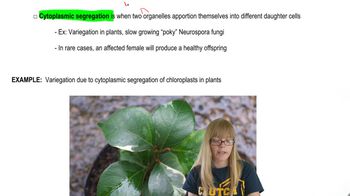
Organelle Inheritance

Pedigree Analysis

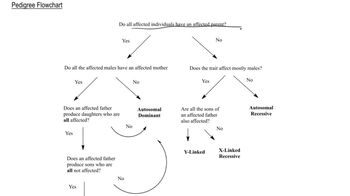
Pedigree analysis is a method used to trace the inheritance patterns of traits or diseases within a family over generations. In a pedigree chart, males are represented by squares and females by circles, with filled shapes indicating affected individuals. By analyzing the pedigree, one can determine the likelihood of offspring inheriting a genetic condition based on the affected individuals in previous generations.
추천 영상:
가이드 코스
01:59
Pedigree Flowchart

Risk Assessment for Offspring

Risk assessment for offspring involves evaluating the probability that children will inherit a genetic condition based on parental genotypes. In the case of mitochondrial diseases like MERRF, if the mother is affected, there is a 100% chance that her children will inherit the mitochondrial DNA, and thus the potential for the disease. The father's genetic contribution does not affect the risk of mitochondrial diseases.
추천 영상:
가이드 코스
06:59
RNA Interference
관련 실천
교과서 질문

A 50-year-old man has been diagnosed with MELAS syndrome. His wife is phenotypically normal, and there is no history of MELAS syndrome in either of their families. The couple is concerned about whether their children will develop the disease. As a genetic counselor, what will you tell them? Would your answer change if it were the mother who exhibited disease symptoms rather than the father?

414
views
교과서 질문

The first person in a family to exhibit Leber hereditary optic neuropathy (LHON) was II-3 in the pedigree shown below, and all of her children also exhibited the disease. Provide two possible explanations as to why II-3's mother (I-1) did not exhibit symptoms of LHON.

565
views
교과서 질문

Consider this human pedigree for a vision defect.

What is the most probable mode of inheritance of the disease? Identify any discrepancies between the pedigree and your proposed mode of transmission, and provide possible explanations for these exceptions. 

512
views
교과서 질문

In 1918, the Russian tsar Nicholas II was deposed, and he and his family were reportedly executed and buried in a shallow grave. During this chaotic time, rumors abounded that the youngest daughter, Anastasia, had escaped. In 1920, a woman in Germany claimed to be Anastasia. In 1979, remains were recovered for the tsar, his wife (the Tsarina Alexandra), and three of their children, but not Anastasia. How would you evaluate the claim of the woman in Germany?

417
views
교과서 질문

What is the most likely mode of inheritance for the trait depicted in the following human pedigree? 

1003
views
교과서 질문

The dodo bird (Raphus cucullatus) lived on the Mauritius Islands until the arrival of European sailors, who quickly hunted the large, placid, flightless bird to extinction. Rapid morphological evolution such as often accompanies island isolation had caused the bird's huge size and obscured its physical resemblance to any near relatives. However, sequencing of mitochondrial DNA from dodo bones reveals that they were pigeons, closely related to the Nicobar pigeon from other islands in the Indian Ocean. Why was mitochondrial DNA suited to the study of this extinct species?

762
views