Ch. 17 - Organelle Inheritance and the Evolution of Organelle Genomes
Sanders - Genetic Analysis: An Integrated Approach 3rd Edition
Sanders3rd EditionGenetic Analysis: An Integrated ApproachISBN: 9780135564172당신이 사용하는 게 아니라요?교과서 변경
17장, 문제 10

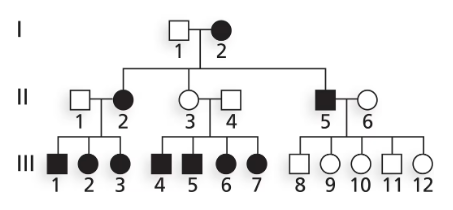
You are a genetic counselor, and several members of the family whose pedigree for an inherited disorder is depicted in Genetic Analysis 17.2 consult with you about the probability that their progeny may be afflicted. What advice would you give individuals III-1, III-2, III-4, III-6, III-8, and III-9?

검증된 단계별 안내
1
Analyze the pedigree chart to determine the inheritance pattern of the disorder. The filled symbols (black squares and circles) represent affected individuals, while the unfilled symbols represent unaffected individuals.
Identify whether the disorder is autosomal dominant, autosomal recessive, X-linked dominant, or X-linked recessive based on the pattern of inheritance. For example, if affected individuals appear in every generation and both males and females are affected, it is likely autosomal dominant.
Determine the genotype of each individual in the pedigree. For autosomal recessive disorders, affected individuals are homozygous recessive (aa), while carriers are heterozygous (Aa). For autosomal dominant disorders, affected individuals are either heterozygous (Aa) or homozygous dominant (AA).
For each individual (III-1, III-2, III-4, III-6, III-8, III-9), calculate the probability of passing on the disorder to their progeny based on their genotype and the genotype of their partner. Use Punnett squares to visualize the inheritance probabilities.
Provide advice to each individual based on the calculated probabilities. For example, if an individual is a carrier of an autosomal recessive disorder, they have a 50% chance of passing the carrier status to their child if their partner is unaffected, and a 25% chance of having an affected child if their partner is also a carrier.

비슷한 문제에 대한 검증된 영상 답변:

이 영상 해법은 위 문제에 도움이 된다고 튜터들이 추천한 것입니다.
영상 길이:
5m

주요 개념

질문에 올바르게 답하기 위해 반드시 이해해야 하는 핵심 개념들은 다음과 같습니다.

Pedigree Analysis

Pedigree analysis is a diagrammatic method used to trace the inheritance patterns of traits or disorders through generations of a family. It helps genetic counselors and researchers understand how a genetic condition is passed down, identifying affected and unaffected individuals, and determining the likelihood of occurrence in future generations.
추천 영상:
가이드 코스
01:59
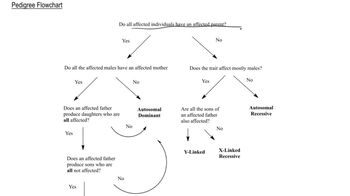
Pedigree Flowchart

Inheritance Patterns

Inheritance patterns refer to the ways in which genetic traits are transmitted from parents to offspring. Common patterns include autosomal dominant, autosomal recessive, X-linked dominant, and X-linked recessive. Understanding these patterns is crucial for predicting the probability of offspring being affected by a genetic disorder based on the genotypes of the parents.
추천 영상:
가이드 코스
05:13
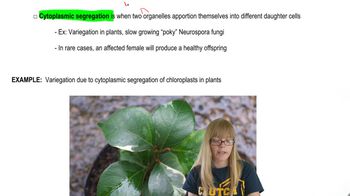
Organelle Inheritance

Genetic Counseling

Genetic counseling is a process that provides individuals and families with information about genetic disorders, including risks, testing options, and implications for health. Counselors help interpret genetic information, guide decision-making, and support families in understanding the emotional and social aspects of genetic conditions, particularly when considering the health of future progeny.
추천 영상:
가이드 코스
03:45
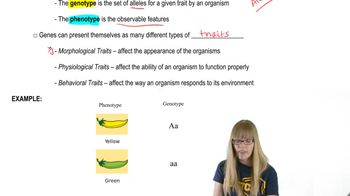
Descriptive Genetics
관련 실천
교과서 질문

What type or types of inheritance are consistent with the following pedigree? 

508
views
교과서 질문

Consider the phylogenetic tree presented in the following figure (Figure 17.17). How were the origins of secondary endosymbiosis in the brown algae determined?

574
views
교과서 질문

Outline the steps required for a gene originally present in the endosymbiont genome to be transferred to the nuclear genome and be expressed, and for its product to be targeted back to the organelle of origin.

521
views
교과서 질문

A mutation in Arabidopsis immutans results in the necrosis (death) of tissues in a mosaic configuration. Examination of the mitochondrial DNA detects deletions of various regions of the mitochondrial genome in the tissues that are necrotic. When immutans plants are crossed with wild-type plants, the  are wild type, and the  are wild type and immutans in a 3:1 ratio. Explain the inheritance of the immutans mutation and a possible origin of the mitochondrial DNA deletions.

462
views
교과서 질문

What is the evidence that the ancient mitochondrial and chloroplast endosymbionts are related to the alphaproteobacteria and cyanobacteria, respectively?

552
views
교과서 질문

You have isolated (1) a streptomycin-resistant mutant (strᴿ) of Chlamydomonas that maps to the chloroplast genome and (2) a hygromycin-resistant mutant (hygᴿ) of Chlamydomonas that maps to the mitochondrial genome. What types of progeny do you expect from the following reciprocal crosses?


mt⁺ strᴿ hygˢ× mt⁻ strˢ hygᴿ

mt⁺ strˢ hygᴿ× mt⁻ strᴿ hygSˢ

435
views