Ch. 4 - Gene Interaction
Sanders - Genetic Analysis: An Integrated Approach 3rd Edition
Sanders3rd EditionGenetic Analysis: An Integrated ApproachISBN: 9780135564172당신이 사용하는 게 아니라요?교과서 변경
4장, 문제 34

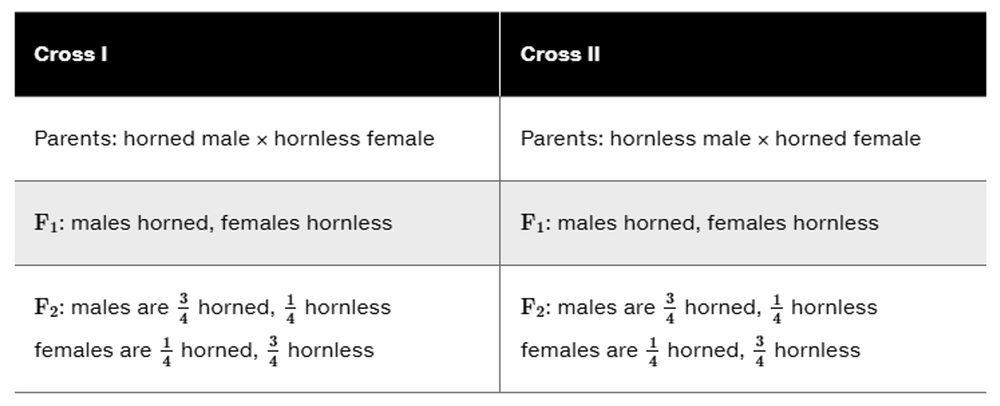
In a breed of domestic cattle, horns can appear on males and on females. Males and females can also be hornless. The following crosses are performed with parents from pure-breeding lines.
Table showing two cattle crosses with horned and hornless parents and offspring ratios by sex for horn presence.
Explain the inheritance of this phenotype in cattle, and assign genotypes to all cattle in each cross.

검증된 단계별 안내
1
Step 1: Understand the phenotype and the inheritance pattern. Horn presence in cattle can be influenced by sex and genotype, often involving sex-influenced or sex-limited traits. Determine if the trait is autosomal or sex-linked, and whether dominance differs between males and females.
Step 2: Define the possible genotypes. For example, let 'H' represent the allele for horns and 'h' for hornlessness. Since the trait appears in both sexes but with different expressions, consider that 'H' might be dominant in males but recessive in females, or vice versa.
Step 3: Analyze the pure-breeding parents. Pure-breeding horned males and females would be homozygous for the horn allele (e.g., HH), and pure-breeding hornless individuals would be homozygous recessive (hh). Assign genotypes accordingly to each parent in the crosses.
Step 4: Predict the genotypes and phenotypes of the offspring from each cross using Punnett squares. Consider sex-specific expression by applying the dominance pattern differently in males and females to determine which offspring will have horns or be hornless.
Step 5: Summarize the inheritance pattern based on the crosses. Explain how the genotype relates to the phenotype in each sex, confirming whether the trait is sex-influenced (same gene, different dominance in sexes) or sex-limited (expressed only in one sex).

비슷한 문제에 대한 검증된 영상 답변:

이 영상 해법은 위 문제에 도움이 된다고 튜터들이 추천한 것입니다.
영상 길이:
1m

주요 개념

질문에 올바르게 답하기 위해 반드시 이해해야 하는 핵심 개념들은 다음과 같습니다.

Sex-Influenced Inheritance

Sex-influenced traits are those where the phenotype expression differs between males and females despite the same genotype. In cattle horn inheritance, the presence or absence of horns can be dominant in one sex but recessive in the other, causing males and females to show different patterns of horn development.
추천 영상:
가이드 코스
07:56
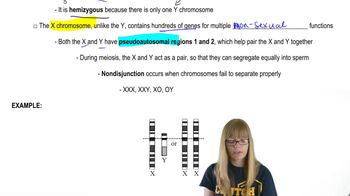
Sex-Linked Genes

Pure-Breeding Lines and Genotype Assignment

Pure-breeding lines are populations that consistently produce offspring with the same phenotype, indicating homozygosity for the trait. Understanding these lines helps assign genotypes to parents and predict offspring genotypes by applying Mendelian inheritance principles.
추천 영상:
가이드 코스
08:06
Mendel's Experiments

Dominance Relationships in Horn Phenotype

The inheritance of horns involves dominance where horned or hornless alleles may show different dominance depending on sex. Recognizing which allele is dominant in males versus females is essential to explain the observed phenotypes and correctly assign genotypes in crosses.
추천 영상:
가이드 코스
04:37
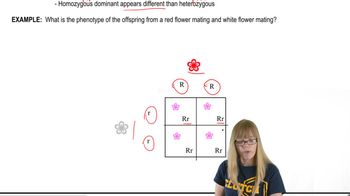
Variations on Dominance
관련 실천
교과서 질문

Human ABO blood type is determined by three alleles, two of which (I^A and I^B) produce gene products that modify the H antigen produced by protein activity of an independently assorting H gene. A rare abnormality known as the 'Bombay phenotype' is the result of epistatic interaction between the gene for the ABO blood group and the H gene. Individuals with the Bombay phenotype appear to have blood type O based on the inability of both anti-A antibody and anti-B antibody to detect an antigen. The apparent blood type O in Bombay phenotype is due to the absence of H antigen as a result of homozygous recessive mutations of the H gene. Individuals with the Bombay phenotype have the hh genotype. Use the information above to make predictions about the outcome of the cross shown below.

IᴬIᴮHh×IᴬIᴮHh

1403
views
교과서 질문

Epistatic gene interaction results in a modification of the F₂ dihybrid ratio.

What is the expected F₂ ratio?

637
views
교과서 질문

In rabbits, albinism is an autosomal recessive condition caused by the absence of the pigment melanin from skin and fur. Pigmentation is a dominant wild-type trait. Three pure-breeding strains of albino rabbits, identified as strains 1, 2, and 3, are crossed to one another. In the table below, F₁ and F₂ progeny are shown for each cross. Based on the available data, propose a genetic explanation for the results. As part of your answer, create genotypes for each albino strain using clearly defined symbols of your own choosing. Use your symbols to diagram each cross, giving the F₁ and F₂ genotypes. <>

997
views
교과서 질문

Cross-1 shown in the following figure illustrates genetic complementation of flower-color mutants. The produced from this cross of two pure-breeding mutant parental plants are dihybrid (CcPp) and have wild-type flower color. If these F₁ are allowed to self-fertilize, what phenotypes are expected in the F₂ , and what are the expected ratios of the phenotypes?


462
views
교과서 질문

Dr. O. Sophila, a close friend of Dr. Ara B. Dopsis, reviews the results Dr. Dopsis obtained in his experiment with iris plants described in Genetic Analysis 4.3. Dr. Sophila thinks the F₂ progeny demonstrate that a single gene with incomplete dominance has produced a 1:2:1 ratio. Dr. Dopsis insists his proposal of recessive epistasis producing a 9:4:3 ratio in the F₂ is correct. To test his proposal, Dr. Dopsis examines the F₂ data under the assumptions of the single-gene incomplete dominance model using chi-square analysis. Calculate and interpret this chi-square value. Can Dr. Dopsis reject the single-gene incomplete dominance model on the basis of this analysis? Explain why or why not.

494
views
교과서 질문

The wild-type allele of a gene has an A–T base pair at a particular location in its sequence, and a mutant allele of the same gene has a G–C base pair at the same location. Otherwise, the sequences of the two alleles are identical. Does this information tell you anything about the dominance relationship of the alleles? Explain why or why not.

495
views