Ch. 9 - The Molecular Biology of Translation
Sanders - Genetic Analysis: An Integrated Approach 3rd Edition
Sanders3rd EditionGenetic Analysis: An Integrated ApproachISBN: 9780135564172당신이 사용하는 게 아니라요?교과서 변경
9장, 문제 B.1b

Answer the following questions for autosomal conditions such as PKU.
Parents who are each heterozygous carriers for a recessive mutant allele have a child who does not have the condition. What is the chance this child is a heterozygous carrier of the condition?

검증된 단계별 안내
1
Identify the genotype of the parents: Since both parents are heterozygous carriers for a recessive mutant allele, their genotypes can be represented as Aa, where A is the normal allele and a is the recessive mutant allele.
Determine the possible genotypes of their child using a Punnett square: The possible genotypes are AA (homozygous normal), Aa (heterozygous carrier), and aa (affected with the condition). The expected genotypic ratio is 1 AA : 2 Aa : 1 aa.
Since the child does not have the condition, exclude the aa genotype from consideration. This leaves the possible genotypes for the child as either AA or Aa.
Calculate the conditional probability that the child is a heterozygous carrier (Aa) given that the child is not affected. Use the formula: \(\text{Probability}\) = \(\frac{\text{Number of }\) Aa \(\text{ genotypes}\)}{\(\text{Number of }\) AA + Aa \(\text{ genotypes}\)}.
Substitute the values from the Punnett square into the formula to find the chance that the child is a heterozygous carrier given they do not have the condition.

비슷한 문제에 대한 검증된 영상 답변:

이 영상 해법은 위 문제에 도움이 된다고 튜터들이 추천한 것입니다.
영상 길이:
2m

주요 개념

질문에 올바르게 답하기 위해 반드시 이해해야 하는 핵심 개념들은 다음과 같습니다.

Autosomal Recessive Inheritance

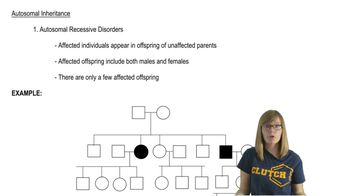
Autosomal recessive inheritance means a condition manifests only when an individual inherits two copies of a mutant allele, one from each parent. Carriers have one normal and one mutant allele but typically do not show symptoms. Understanding this pattern helps predict the likelihood of offspring being affected or carriers.
추천 영상:
가이드 코스
09:08
Autosomal Pedigrees

Genotype Probabilities in Carrier Parents

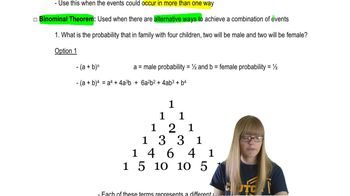
When both parents are heterozygous carriers, each child has a 25% chance of being affected (homozygous recessive), 50% chance of being a carrier (heterozygous), and 25% chance of being unaffected and not a carrier (homozygous dominant). These probabilities are derived from a Punnett square analysis.
추천 영상:

Conditional Probability Given Phenotype

If a child does not have the condition (is unaffected), the probability that the child is a carrier changes because the affected genotype is excluded. This requires calculating the conditional probability of being heterozygous given the child is not affected, adjusting the original genotype probabilities accordingly.
추천 영상: