Ch. 9 - The Molecular Biology of Translation
Sanders - Genetic Analysis: An Integrated Approach 3rd Edition
Sanders3rd EditionGenetic Analysis: An Integrated ApproachISBN: 9780135564172당신이 사용하는 게 아니라요?교과서 변경
9장, 문제 37

In terms of the polycistronic composition of mRNAs and the presence or absence of Shine–Dalgarno sequences, compare and contrast bacterial, archaeal, and eukaryotic mRNAs.

검증된 단계별 안내
1
span>Step 1: Understand the concept of polycistronic mRNA. In bacteria and archaea, mRNAs can be polycistronic, meaning they can encode multiple proteins within a single mRNA molecule. In contrast, eukaryotic mRNAs are typically monocistronic, encoding only one protein per mRNA.
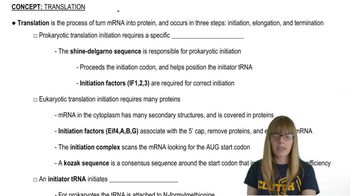
span>Step 2: Explore the role of the Shine–Dalgarno sequence. This sequence is a ribosomal binding site in bacterial and archaeal mRNA, located upstream of the start codon. It helps the ribosome recognize the start site for translation.
span>Step 3: Compare bacterial and archaeal mRNAs. Both can be polycistronic and contain Shine–Dalgarno sequences, but there may be differences in the specific sequences and mechanisms of translation initiation between these two domains.
span>Step 4: Contrast with eukaryotic mRNAs. Eukaryotic mRNAs are generally monocistronic and do not have Shine–Dalgarno sequences. Instead, they use a 5' cap structure and a Kozak sequence to facilitate ribosome binding and translation initiation.
span>Step 5: Summarize the differences. Bacterial and archaeal mRNAs can be polycistronic and use Shine–Dalgarno sequences, while eukaryotic mRNAs are typically monocistronic and use different mechanisms for translation initiation.

비슷한 문제에 대한 검증된 영상 답변:

이 영상 해법은 위 문제에 도움이 된다고 튜터들이 추천한 것입니다.
영상 길이:
2m

주요 개념

질문에 올바르게 답하기 위해 반드시 이해해야 하는 핵심 개념들은 다음과 같습니다.

Polycistronic mRNA

Polycistronic mRNA is a type of messenger RNA that encodes multiple proteins within a single transcript. This is common in prokaryotes, such as bacteria and archaea, allowing for the coordinated expression of genes that are functionally related. In contrast, eukaryotic mRNAs are typically monocistronic, meaning they encode only one protein per transcript, which allows for more complex regulation of gene expression.
추천 영상:
가이드 코스
08:39
mRNA Processing

Shine-Dalgarno Sequence

The Shine-Dalgarno sequence is a ribosomal binding site in bacterial mRNA that is crucial for the initiation of translation. It is a short, conserved sequence located upstream of the start codon, facilitating the alignment of the ribosome with the mRNA. In archaea, similar sequences exist, but eukaryotic mRNAs do not have Shine-Dalgarno sequences; instead, they utilize a 5' cap structure for ribosome binding.
추천 영상:
가이드 코스
08:41
Sequencing Difficulties

Transcription and Translation Differences

Transcription and translation processes differ significantly between prokaryotes and eukaryotes. In prokaryotes, transcription and translation occur simultaneously in the cytoplasm, while in eukaryotes, transcription occurs in the nucleus, and mRNA must be processed (including splicing and capping) before it is translated in the cytoplasm. This separation allows for more complex regulation in eukaryotic cells.
추천 영상:
가이드 코스
07:58
Translation initiation
관련 실천
교과서 질문

The six nucleotides preceding the start codon and the first nucleotide after the start codon in eukaryotes exhibit strong sequence conservation as determined by the percentages of nucleotides in the  to  positions and the  position (see Problem 34). Use the data given in the table for Problem 35 to determine the seven nucleotides that most commonly surround the start in vertebrates.

434
views
교과서 질문

Answer the following questions about the accompanying diagram.

Is the DNA nearest A the template strand or the coding strand?

472
views
교과서 질문

Organisms of all three domains of life usually use the mRNA codon AUG as the start codon.

Despite AUG being the most common start codon sequence, very few proteins have methionine as the first amino acid. Why is this the case?

393
views
교과서 질문

Organisms of all three domains of life usually use the mRNA codon AUG as the start codon.

Do organisms of the three domains use the same amino acid as the initial amino acid in translation? Identify similarities and differences.

583
views
교과서 질문

Table D lists α-globin and β-globin gene sequences for the 11 or 12 nucleotides preceding the start codon and the first nucleotide following the start codon (see Problem 34). The data are for 16 vertebrate globin genes reported by Kozak (1987). The sequences are written from -12 to +4 with the start codon sequence in capital letters. Use the data in this table to:

Compare the consensus sequence for these globin genes to the consensus sequence derived from the larger study of 699 vertebrate genes in Problem 34. 

553
views
교과서 질문

Table D lists α-globin and β-globin gene sequences for the 11 or 12 nucleotides preceding the start codon and the first nucleotide following the start codon (see Problem 34). The data are for 16 vertebrate globin genes reported by Kozak (1987). The sequences are written from -12 to +4 with the start codon sequence in capital letters. Use the data in this table to:

Determine the consensus sequence for the 16 selected α-globin and β-globin genes.

549
views