 뒤로
뒤로GOB Chemistry: Chemical Kinetics
 02:16
02:16
이 집합의 용어 (27)
Chemical kinetics is the study of how fast chemical reactions occur and provides insight into the reaction mechanism.
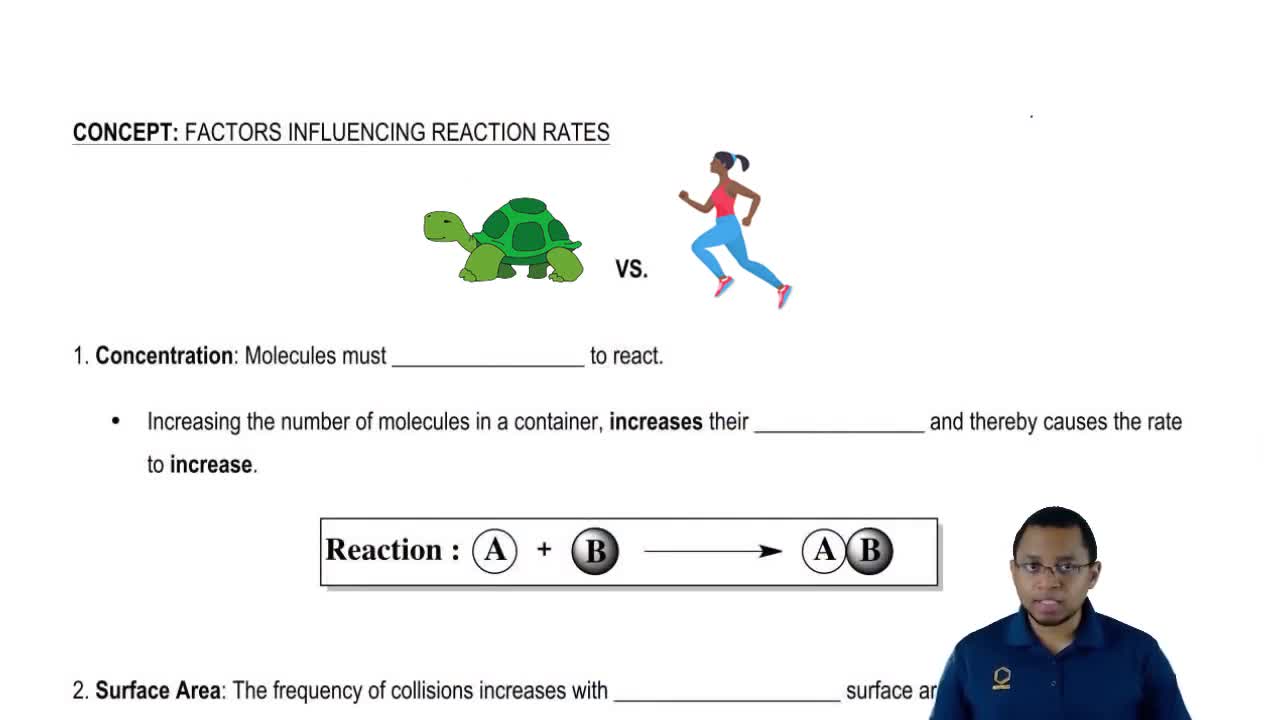
Physical state, concentration, temperature, and presence of a catalyst.
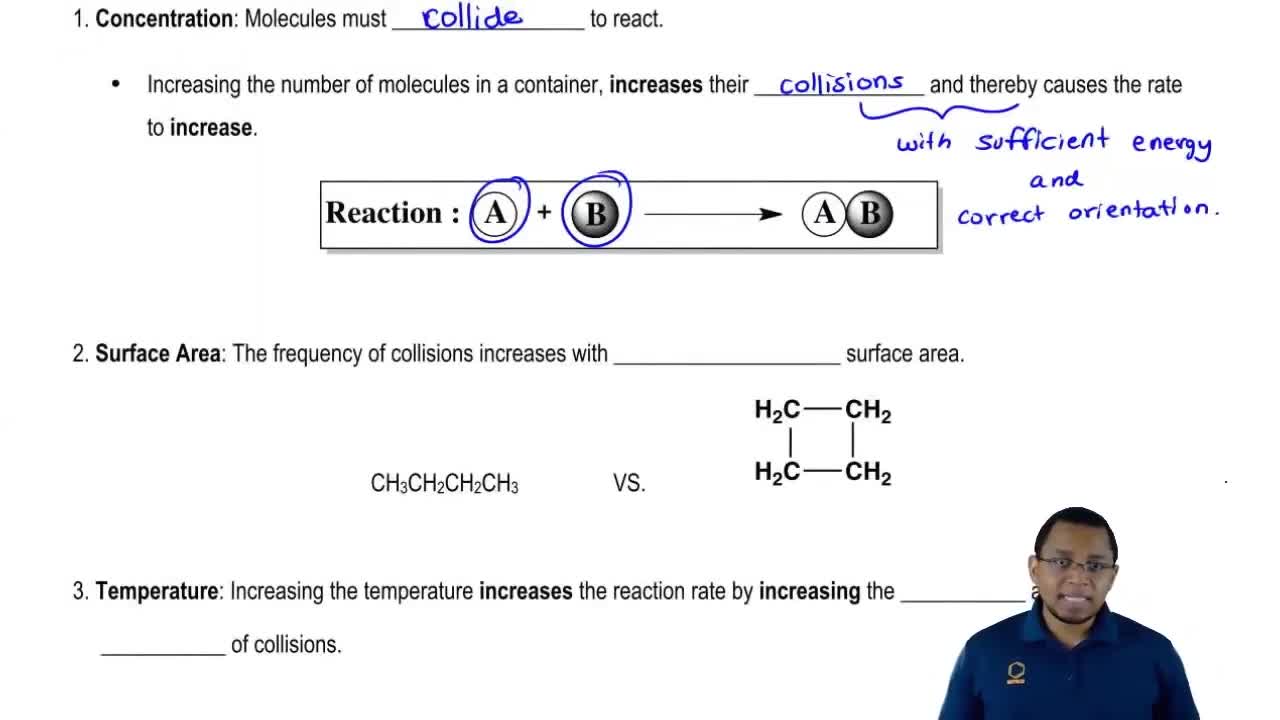
More homogeneous mixtures and larger surface areas increase the frequency of molecular collisions, speeding up reactions.
Powder has a larger surface area, no disintegration step, and immediate availability, leading to faster absorption.
Increasing reactant concentration increases collision frequency, thus increasing the reaction rate.
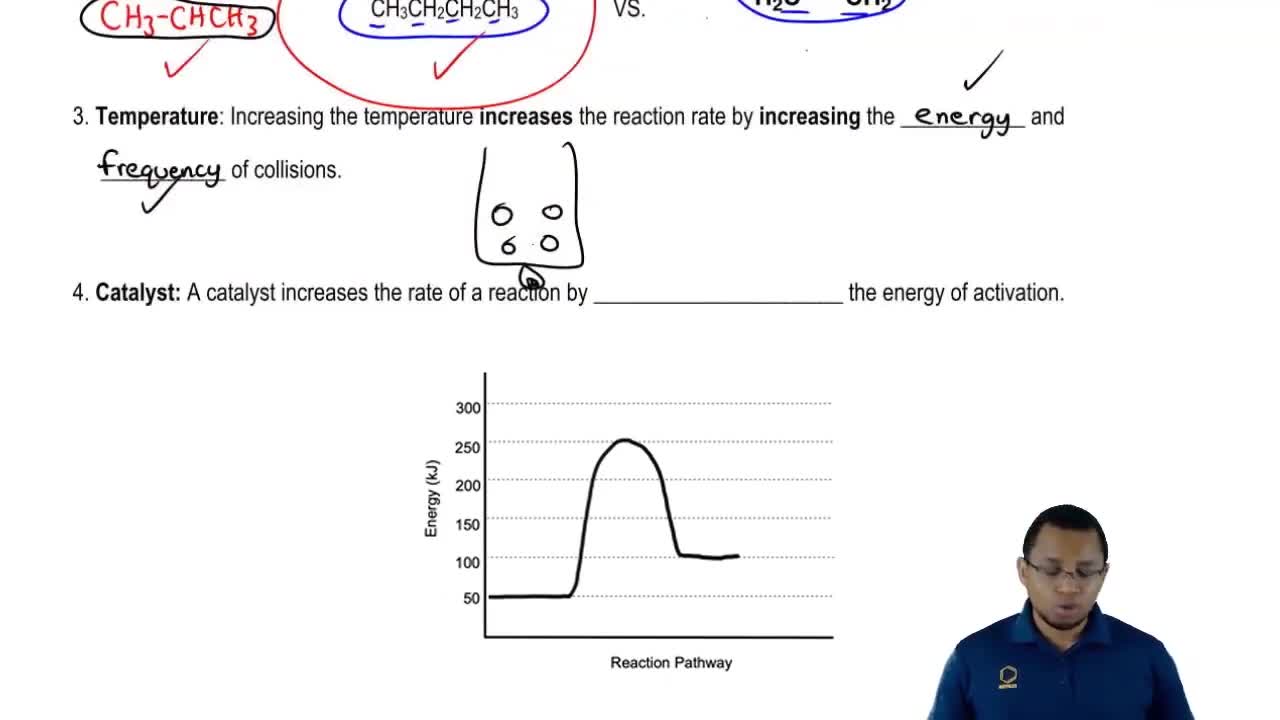
Higher temperatures increase molecular kinetic energy, causing more frequent and energetic collisions, speeding up reactions.
Catalysts speed up reactions by changing the reaction mechanism and lowering activation energy without being consumed.
Average rate = change in concentration of B over change in time, \(\frac{\Delta[B]}{\Delta t}\).
Average rate is over a time interval; instantaneous rate is the rate at a specific moment, given by the slope of the tangent to the concentration-time curve.
Rates are related to reactant/product changes divided by their stoichiometric coefficients, e.g., for 2 HI → H2 + I2, rate = −(1/2)Δ[HI]/Δt = Δ[H2]/Δt.
Rate = k[reactant 1]m[reactant 2]n, where m and n are reaction orders determined experimentally.
Zero order: rate unaffected by concentration change; first order: rate doubles when concentration doubles; nth order: rate changes by 2n when concentration doubles.
First order: s−1; second order: M−1s−1.
ln[A]t = −kt + ln[A]0, where [A]t is concentration at time t.
A plot of ln[A] versus time yields a straight line with slope −k.
t1/2 = 0.693 / k, independent of initial concentration.
t1/2 = 1 / (k[A]0), inversely proportional to initial concentration.
Reactions occur when molecules collide with proper orientation and sufficient energy to overcome activation energy.
Activation energy is the minimum energy required for reactants to form products by overcoming the energy barrier.
k = A e−Ea/RT, where k is rate constant, A is frequency factor, Ea is activation energy, R is gas constant, and T is temperature in K.
By plotting ln k versus 1/T and calculating the slope, which equals −Ea/R.
A sequence of elementary steps describing how reactants convert to products at the molecular level.
The number of molecules involved in a single elementary step: unimolecular, bimolecular, or termolecular.
The slowest elementary step that controls the overall reaction rate.
By lowering the activation energy and providing an alternative reaction pathway without being consumed.
Homogeneous catalysts are in the same phase as reactants; heterogeneous catalysts are in a different phase, often solid surfaces.
Enzymes have specific active sites where substrates bind like a key in a lock, speeding up specific biochemical reactions.