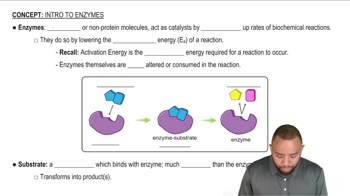
Enzymes are proteins that act as biological catalysts, increasing reaction rates by lowering activation energy.
What is the active site of an enzyme?
The active site is a small region on the enzyme surface that binds the substrate and catalyzes a specific reaction.
How are enzyme names derived?
Enzyme names are derived by replacing the end of the reaction or substrate name with the suffix ase, e.g., sucrase catalyzes sucrose.
What are the six main classes of enzymes based on reaction type?
The six classes include hydrolases, isomerases, transferases, ligases, among others, classified by the reactions they catalyze.
Match enzyme classes to their reactions: hydrolases, isomerases, transferases, ligases.
Hydrolases: hydrolysis reactions; Isomerases: rearrange atoms to form isomers; Transferases: transfer groups between compounds; Ligases: form bonds using ATP energy.
Describe the lock-and-key model of enzyme action.
The active site has a rigid, nonflexible shape and binds only substrates that exactly fit like a key in a lock.
Describe the induced-fit model of enzyme action.
The enzyme structure is flexible and adjusts its active site shape to bind the substrate, improving catalysis.
What is an enzyme-substrate (E S) complex?
It is the temporary complex formed when a substrate binds to the enzyme's active site during catalysis.
How does the enzyme lactase catalyze lactose hydrolysis?
Lactose binds to lactase's active site forming an E S complex; amino acid R groups catalyze hydrolysis into glucose and galactose.
What are isoenzymes?
Isoenzymes are different forms of an enzyme that catalyze the same reaction in different tissues with slight amino acid variations.
How are lactate dehydrogenase (L D H) isoenzymes used diagnostically?
Different L D H isoenzymes indicate damage to specific organs, e.g., heart or liver, by their presence in blood serum.
What factors affect enzyme activity?
Enzyme activity is affected by temperature, pH, substrate concentration, and inhibitors.
What is the optimum temperature for enzyme activity?
Enzymes have an optimum temperature where activity is highest; activity decreases at low temperatures and denatures at high temperatures.
How does pH affect enzyme activity?
Enzymes have an optimum pH; activity decreases if pH is too low or high due to disruption of amino acid R group charges and tertiary structure.
What is competitive inhibition?
A competitive inhibitor resembles the substrate and competes for the active site; inhibition can be reversed by increasing substrate concentration.
What is noncompetitive inhibition?
A noncompetitive inhibitor binds elsewhere on the enzyme, changing its shape and preventing substrate binding; inhibition is not reversed by more substrate.
What is irreversible inhibition?
Irreversible inhibitors form covalent bonds with enzymes, permanently inactivating them; often toxic substances like nerve gases or insecticides.
How can you distinguish competitive from noncompetitive inhibitors?
Competitive inhibitors are reversed by more substrate and bind active site; noncompetitive bind elsewhere and are not reversed by substrate.
What happens to enzyme activity when pH changes from optimum?
Enzyme activity decreases because the enzyme's tertiary structure and active site charges are disrupted.
What is the role of amino acid R groups in the active site?
R groups bind the substrate and catalyze the reaction by stabilizing the transition state or participating in chemical changes.
 뒤로
 2:14