뒤로

GOB Chemistry: Lipids and Fatty Acids 19.1

컨트롤 버튼이 '내비게이션' 모드로 변경되었습니다.
1/23
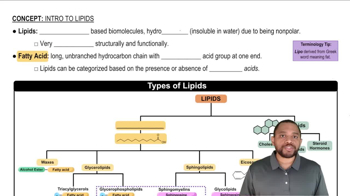
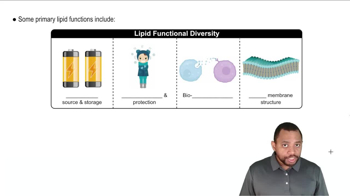
  • What are the general functions of lipids?

    • Protection (waxes)
    • Energy storage (triacylglycerols)
    • Membrane structure (glycerophospholipids, steroids)
    • Nerve insulation (sphingolipids)
    • Hormones (steroids)
    • Messengers (eicosanoids, glycolipids)
  • What is the general structure of a fatty acid?

    A long-chain carboxylic acid with a hydrophilic carboxyl head and a hydrophobic hydrocarbon tail.
  • What is the general structure of a triacylglycerol?

    Glycerol backbone esterified to three fatty acid chains.
  • Difference between saturated and unsaturated fats?

    Saturated fats have no double bonds; unsaturated fats have one or more C=C double bonds.
  • Difference between monounsaturated and polyunsaturated fats?

    Monounsaturated fats have one double bond; polyunsaturated fats have multiple double bonds.
  • Which fatty acids are essential?

    Linoleic acid and linolenic acid are essential fatty acids that must be obtained from diet.
  • Difference between a fat and an oil?

    Fats are solid at room temperature with more saturated fatty acids; oils are liquid with more unsaturated fatty acids.
  • What are the three reactions involving triacylglycerols?

    Biochemical energy storage, hydrolysis (saponification), and hydrogenation.
  • What determines the melting temperature of a fatty acid?

    Chain length (longer = higher melting point) and degree of saturation (more double bonds = lower melting point).
  • What is the structure of a saturated fatty acid (example: palmitic acid)?

    A long hydrocarbon chain with only single bonds and a terminal carboxyl group.
  • What is the structure of an unsaturated fatty acid (example: oleic acid)?

    Contains one or more cis double bonds causing kinks in the hydrocarbon chain.
  • How do double bonds affect fatty acid packing?

    Double bonds create kinks that prevent tight packing, lowering melting points.
  • What is the iodine number?

    The grams of iodine that react with 100g of fat or oil; indicates degree of unsaturation.
  • What are trans fatty acids?

    Unsaturated fats with trans double bonds, not naturally occurring, increase LDL and heart disease risk.
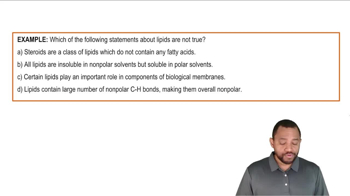
  • What are the main components of cell membranes?

    Phospholipids, cholesterol, glycolipids, and proteins.
  • What is the role of cholesterol in membranes?

    Adds rigidity and stability to the membrane.
  • From what metabolite is cholesterol synthesized?

    Acetyl-CoA.
  • What chemicals are made from cholesterol?

    Steroid hormones, bile acids, and vitamin D.
  • Difference between active and passive transport?

    Active transport requires energy; passive transport does not.
  • Difference between simple and facilitated diffusion?

    Simple diffusion passes directly through membrane; facilitated diffusion uses protein channels.
  • Which lipids trigger inflammation and allergic responses?

    Eicosanoids such as prostaglandins and leukotrienes.
  • Which lipids affect blood pressure and blood clotting?

    Prostaglandins and other eicosanoids.
  • What type of inhibition does aspirin use to block prostaglandin production?

    Irreversible inhibition.