It is inhibited by high energy molecules (Acetyl-CoA, ATP, NADH) and activated by low energy molecules (NAD+, AMP, CoA-SH).
Which TCA cycle steps produce reduced coenzymes and CO2?
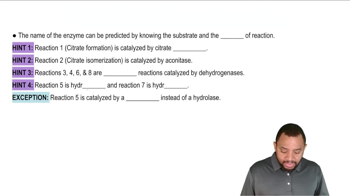
Steps catalyzed by isocitrate dehydrogenase, α-ketoglutarate dehydrogenase, and malate dehydrogenase produce NADH and CO2; succinate dehydrogenase produces FADH2.
What is the net production of reduced coenzymes and ATP per glucose in the TCA cycle?
6 NADH, 2 FADH2, and 2 ATP (or GTP) are produced per glucose molecule.
Which enzymes in the TCA cycle are regulated and how?
Citrate synthase, isocitrate dehydrogenase, and α-ketoglutarate dehydrogenase are regulated allosterically by energy status molecules like ATP, NADH, ADP, and AMP.
Classify the enzyme citrate synthase by enzyme class.
Citrate synthase is a ligase, catalyzing bond formation coupled with ATP hydrolysis.
What is the role of the electron transport chain (ETC)?
The ETC couples oxidation of NADH and FADH2 to proton pumping, creating a gradient used to synthesize ATP via oxidative phosphorylation.
Which complexes in the ETC pump protons across the membrane?
Complexes I, III, and IV are proton pumps; Complex II does not pump protons.
What are the substrates and products of Complex I in the ETC?
Substrate: NADH; Product: NAD+, electrons transferred to ubiquinone (CoQ), and protons pumped.
What is the final electron acceptor in the ETC?
Molecular oxygen (O2) is the final electron acceptor, forming water (H2O).
How does ATP synthase produce ATP?
ATP synthase uses the energy from protons flowing down their gradient through its channel to phosphorylate ADP to ATP.
Why is membrane potential important for ATP synthesis?
The proton gradient across the inner mitochondrial membrane stores potential energy essential for driving ATP synthesis.
Why are NADH and FADH2 considered high energy molecules?
They carry high-energy electrons that release energy when oxidized in the ETC to pump protons and generate ATP.
What is the net ATP yield from complete oxidation of one glucose molecule?
Approximately 38 ATP molecules are produced from glycolysis, TCA cycle, and oxidative phosphorylation combined.
What happens to the remaining 60% of energy from glucose oxidation?
It is released as heat to help maintain body temperature.
How is the electron transport chain inhibited?
It is inhibited by high energy molecules like ATP and NADH, which signal sufficient energy availability.
What is the role of Coenzyme Q (ubiquinone) in the ETC?
CoQ transfers electrons from Complexes I and II to Complex III.
 뒤로
 1:21