 뒤로
lecture 15
 1:23

이 집합의 용어 (20)
Solar energy is the ultimate source of energy on Earth, captured by plants through photosynthesis.
Plants convert solar energy into chemical energy (glucose), which animals consume. Animals release CO2 used by plants, creating an energy cycle.
Energy must be released gradually, stored accessibly, released precisely when needed, maintain body temperature, and drive non-favorable chemical reactions.
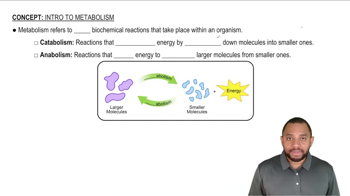
All chemical reactions in an organism, including anabolism (building molecules) and catabolism (breaking down molecules for energy).
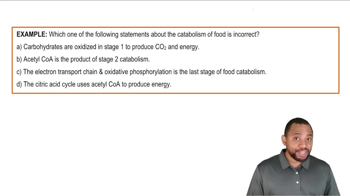
1) Digestion of macromolecules, 2) Breakdown into oxidized forms (acetyl-CoA), 3) Oxidation of acetyl-CoA to CO2 and reduced coenzymes, 4) Oxidative phosphorylation producing ATP and H2O.
Exergonic reactions release energy (ΔG negative), occur spontaneously. Endergonic reactions require energy input (ΔG positive), nonspontaneous.
Coupling allows energy released from exergonic reactions to drive endergonic reactions, making overall process spontaneous.
1) Highly exergonic and irreversible, 2) Have a committed step, 3) Are regulated, 4) Occur in specific cellular locations.
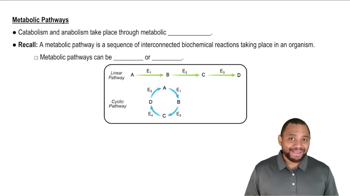
Linear (sequential reactions), Cyclic (regenerates initial substrate), Spiral (polymer breakdown one monomer at a time).
High energy molecules include ATP, Acetyl-CoA, NADH, and FADH2.
NAD+ and FAD are oxidized forms; NADH and FADH2 are reduced forms carrying electrons in redox reactions.
Vitamins like niacin (B3) and riboflavin (B2) are precursors for coenzymes NAD+/NADH and FAD/FADH2, essential for redox reactions.
ATP hydrolysis releases moderate energy, is stable at pH 7, requires enzymes for hydrolysis, and its bonds are easily cleaved due to charge repulsion.
Coupled reactions link exergonic and endergonic processes so energy released drives energy-requiring reactions, enabling cellular work.
Acetyl-CoA carbons are oxidized to CO2, and coenzymes NAD+ and FAD are reduced to NADH and FADH2.
A highly regulated, often irreversible step that commits substrates to a specific pathway.
Glycolysis: cytosol; TCA cycle: mitochondrial matrix; Electron transport chain: inner mitochondrial membrane.
ΔG = -7.3 kcal/mol, indicating an exergonic reaction releasing energy.
Because breaking phosphate anhydride bonds relieves charge repulsion and produces more stable products.
True. AMP can be converted back to ATP through cellular processes.