 뒤로
lecture 15.2
 1:29

이 집합의 용어 (20)
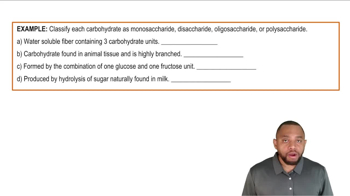
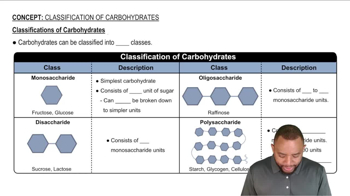
Monosaccharides are simple sugars that cannot be hydrolyzed into smaller sugars. Disaccharides consist of two monosaccharides linked together. Polysaccharides are polymers of many monosaccharides.
Aldoses contain an aldehyde group, while ketoses contain a ketone group in their structure.
The three types are D & L isomers (enantiomers), diastereomers, and anomers.
If the -OH group on the chiral carbon farthest from the carbonyl is on the right, it is a D-isomer. If on the left, it is an L-isomer.
Anomers are cyclic sugars differing only in the position of the substituent at the hemiacetal (anomeric) carbon, existing as alpha or beta forms.
A reducing sugar has a free anomeric carbon with a hemiacetal group that can be oxidized, allowing it to reduce other chemicals.
Because its anomeric carbons of glucose and fructose are involved in the glycosidic bond, preventing oxidation.
A bond between the anomeric carbon of a monosaccharide and an -OR group, forming acetals or glycosides in carbohydrates.
By the configuration of the anomeric carbon involved in the glycosidic bond.
Maltose (glucose + glucose), lactose (galactose + glucose), and sucrose (glucose + fructose).
Maltose: α-1,4, Lactose: β-1,4, Sucrose: α-1,β-2 linkages.
Sucralose resembles sucrose in structure.
Aspartame is made from amino acids.
Sugar feeds bacteria like Streptococcus mutans, which produce acid that lowers pH and dissolves tooth enamel, causing decay.
Carbohydrates provide energy, form metabolic intermediates, act as anticoagulants and lubricants, serve as cell surface receptors, and determine blood type.
Type O blood lacks A and B carbohydrate antigens on red blood cells, so it is not recognized as foreign by recipients.
Glycogen and starch have α-1,4 and α-1,6 linkages with branching; cellulose has β-1,4 linkages forming straight chains.
Humans can digest glycogen and starch but not cellulose due to lack of enzymes for β-1,4 bonds.
Phosphorylated sugars are high-energy intermediates essential for energy generation and biosynthesis.
Heparin is a highly charged polysaccharide that acts as an anticoagulant by binding blood clotting factors.