Ch.12 Food as Fuel An Overview of Metabolism
Frost - General, Organic and Biological Chemistry 4th Edition
Frost4th EditionGeneral, Organic and Biological ChemistryISBN: 9780134988696당신이 사용하는 게 아니라요?교과서 변경
8장, 문제 88

What is the effect of proton accumulation in the intermembrane space?

검증된 단계별 안내
1
Understand the context: Proton accumulation in the intermembrane space occurs during cellular respiration, specifically in the electron transport chain within mitochondria. This process is crucial for ATP synthesis.
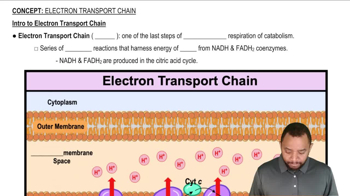
Recognize the role of protons: As electrons move through the electron transport chain, protons (H⁺ ions) are actively pumped from the mitochondrial matrix into the intermembrane space, creating a proton gradient.
Explain the proton gradient: The accumulation of protons in the intermembrane space leads to a higher concentration of H⁺ ions compared to the matrix. This creates an electrochemical gradient, also known as the proton motive force.
Describe the effect of the gradient: The proton motive force drives protons back into the mitochondrial matrix through ATP synthase, a protein complex. This movement of protons provides the energy needed for the synthesis of ATP from ADP and inorganic phosphate.
Summarize the importance: Proton accumulation in the intermembrane space is essential for energy production in cells. Without this gradient, ATP synthesis would not occur efficiently, impacting cellular functions and overall energy availability.

비슷한 문제에 대한 검증된 영상 답변:

이 영상 해법은 위 문제에 도움이 된다고 튜터들이 추천한 것입니다.
영상 길이:
5m

주요 개념

질문에 올바르게 답하기 위해 반드시 이해해야 하는 핵심 개념들은 다음과 같습니다.

Proton Accumulation

Proton accumulation refers to the buildup of hydrogen ions (H+) in a specific area, such as the intermembrane space of mitochondria. This process is crucial for cellular respiration, as it creates a proton gradient that drives ATP synthesis. The concentration of protons influences the electrochemical gradient, which is essential for energy production in cells.
추천 영상:

Intermembrane Space

The intermembrane space is the region between the inner and outer membranes of mitochondria. It plays a vital role in the electron transport chain, where protons are pumped from the mitochondrial matrix into this space. The resulting proton gradient is used by ATP synthase to generate ATP, the energy currency of the cell, during oxidative phosphorylation.
추천 영상:
가이드 코스
3:10
Intro to Electron Transport Chain Concept 1

ATP Synthesis

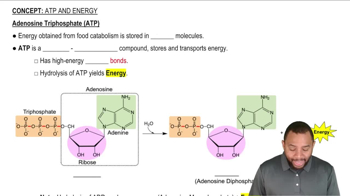
ATP synthesis is the process by which adenosine triphosphate (ATP) is produced, primarily in mitochondria through oxidative phosphorylation. The energy stored in the proton gradient created by proton accumulation is harnessed by ATP synthase to convert adenosine diphosphate (ADP) and inorganic phosphate into ATP. This process is fundamental for providing energy for various cellular functions.
추천 영상:
가이드 코스
2:20
Adenosine Triphosphate (ATP) Concept 2