Ch.12 Food as Fuel An Overview of Metabolism
Frost - General, Organic and Biological Chemistry 4th Edition
Frost4th EditionGeneral, Organic and Biological ChemistryISBN: 9780134988696당신이 사용하는 게 아니라요?교과서 변경
8장, 문제 28

Name the coenzyme produced during the conversion of pyruvate to acetyl CoA.

검증된 단계별 안내
1
Understand the context: The conversion of pyruvate to acetyl CoA is a key step in cellular respiration, specifically in the link reaction between glycolysis and the citric acid cycle.
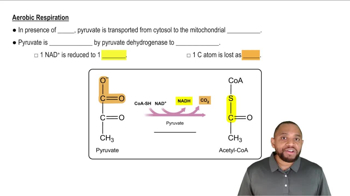
Identify the chemical process: During this reaction, pyruvate undergoes oxidative decarboxylation, which involves the removal of a carbon atom as carbon dioxide (CO2).
Recognize the role of coenzymes: Coenzymes are molecules that assist enzymes in catalyzing reactions. In this process, a coenzyme is reduced as electrons are transferred.
Determine the specific coenzyme involved: The coenzyme that is reduced during this reaction is NAD+, which becomes NADH as it accepts electrons and a hydrogen ion.
Conclude the naming: The coenzyme produced during the conversion of pyruvate to acetyl CoA is NADH, which plays a crucial role in carrying electrons to the electron transport chain.

비슷한 문제에 대한 검증된 영상 답변:

이 영상 해법은 위 문제에 도움이 된다고 튜터들이 추천한 것입니다.
영상 길이:
3m

주요 개념

질문에 올바르게 답하기 위해 반드시 이해해야 하는 핵심 개념들은 다음과 같습니다.

Pyruvate Decarboxylation

Pyruvate decarboxylation is the process by which pyruvate, derived from glycolysis, is converted into acetyl CoA. This reaction occurs in the mitochondria and involves the removal of a carbon atom from pyruvate, releasing it as carbon dioxide. This step is crucial for linking glycolysis to the citric acid cycle.
추천 영상:
가이드 코스
1:38
Pyruvate Oxidation Concept 2

Coenzyme A (CoA)

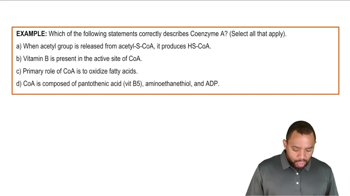
Coenzyme A (CoA) is a vital coenzyme that plays a key role in the metabolism of fatty acids and the citric acid cycle. It acts as a carrier of acyl groups, facilitating the transfer of acetyl groups to various metabolic pathways. In the conversion of pyruvate to acetyl CoA, CoA is essential for the formation of acetyl CoA from the decarboxylated pyruvate.
추천 영상:
가이드 코스
1:10
Coenzyme A Example 4

NAD+ and NADH

NAD+ (nicotinamide adenine dinucleotide) is a coenzyme that functions as an electron carrier in various metabolic reactions, including the conversion of pyruvate to acetyl CoA. During this process, NAD+ is reduced to NADH, capturing high-energy electrons. This conversion is crucial for energy production and is a key step in cellular respiration.
추천 영상:
가이드 코스
1:43
Intro to Electron Transport Chain Example 1