Ch.12 Food as Fuel An Overview of Metabolism
Frost - General, Organic and Biological Chemistry 4th Edition
Frost4th EditionGeneral, Organic and Biological ChemistryISBN: 9780134988696당신이 사용하는 게 아니라요?교과서 변경
8장, 문제 80c

Refer to the diagram of the citric acid cycle in Figure 12.11 to answer each of the following:
c. Name the reaction that is coupled to GTP formation.

검증된 단계별 안내
1
Identify the step in the citric acid cycle where GTP (or ATP, depending on the organism) is formed. This occurs during the conversion of succinyl-CoA to succinate.
Understand that this reaction is catalyzed by the enzyme succinyl-CoA synthetase (also known as succinate thiokinase).
Recognize that the reaction involves substrate-level phosphorylation, where a high-energy thioester bond in succinyl-CoA is used to drive the formation of GTP (or ATP).
Note that the reaction can be summarized as: succinyl-CoA+GDP+Pi→succinate+GTP+CoA-SH.
Conclude that the reaction coupled to GTP formation is the conversion of succinyl-CoA to succinate, which is an example of substrate-level phosphorylation.

비슷한 문제에 대한 검증된 영상 답변:

이 영상 해법은 위 문제에 도움이 된다고 튜터들이 추천한 것입니다.
영상 길이:
3m

주요 개념

질문에 올바르게 답하기 위해 반드시 이해해야 하는 핵심 개념들은 다음과 같습니다.

Citric Acid Cycle

The citric acid cycle, also known as the Krebs cycle, is a series of chemical reactions used by all aerobic organisms to generate energy. It takes place in the mitochondria and involves the oxidation of acetyl-CoA to produce ATP, NADH, and FADH2, which are crucial for cellular respiration.
추천 영상:
가이드 코스
2:31
Citric Acid Cycle Summary Concept 12

GTP Formation

GTP (guanosine triphosphate) formation occurs during the citric acid cycle, specifically in the conversion of succinyl-CoA to succinate. This reaction is catalyzed by the enzyme succinyl-CoA synthetase and is an example of substrate-level phosphorylation, where a phosphate group is directly transferred to GDP to form GTP.
추천 영상:
가이드 코스
1:41
Amide Formation Concept 1

Coupled Reactions

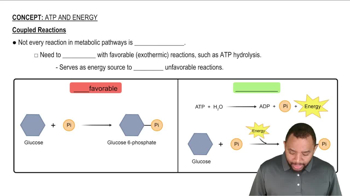
Coupled reactions involve linking an energetically unfavorable reaction with a favorable one to drive the overall process. In the context of the citric acid cycle, the reaction that produces GTP is coupled with the hydrolysis of the thioester bond in succinyl-CoA, which releases energy and makes the formation of GTP thermodynamically favorable.
추천 영상:
가이드 코스
1:46
Coupled Reactions Concept 3