Ch.6 Carbohydrates Life's Sweet Molecules
Frost - General, Organic and Biological Chemistry 4th Edition
Frost4th EditionGeneral, Organic and Biological ChemistryISBN: 9780134988696당신이 사용하는 게 아니라요?교과서 변경
3장, 문제 63b

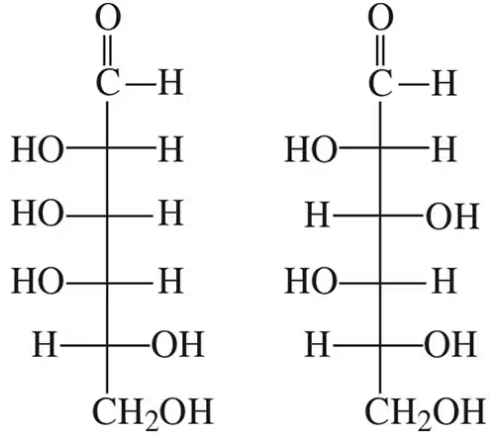
How are the following pairs of carbohydrates, shown in a Fischer projection, related to each other? Are they structural isomers, enantiomers, diastereomers, or epimers? Identify each as the D- or L-isomer. 
(b) Fischer projections of two carbohydrate pairs, illustrating their relationships as isomers or enantiomers.

검증된 단계별 안내
1
Step 1: Begin by understanding the definitions of the terms: structural isomers, enantiomers, diastereomers, and epimers. Structural isomers have the same molecular formula but different connectivity. Enantiomers are non-superimposable mirror images. Diastereomers are stereoisomers that are not mirror images. Epimers are a specific type of diastereomer that differ at only one stereocenter.
Step 2: Examine the Fischer projections of the two carbohydrates provided in the image. Identify the stereocenters (chiral carbons) and note the arrangement of substituents (hydroxyl groups, hydrogen atoms, etc.) around each stereocenter.
Step 3: Compare the configurations of the stereocenters between the two carbohydrates. Determine if all stereocenters are opposite (indicating enantiomers), if only one stereocenter differs (indicating epimers), or if multiple stereocenters differ but not all (indicating diastereomers). If the connectivity differs, they are structural isomers.
Step 4: Identify whether each carbohydrate is a D- or L-isomer. This is determined by the configuration of the hydroxyl group on the penultimate carbon (the second-to-last carbon in the chain). If the hydroxyl group is on the right in the Fischer projection, it is a D-isomer; if on the left, it is an L-isomer.
Step 5: Summarize the relationship between the two carbohydrates based on your analysis. Clearly state whether they are structural isomers, enantiomers, diastereomers, or epimers, and identify each as the D- or L-isomer.

비슷한 문제에 대한 검증된 영상 답변:

이 영상 해법은 위 문제에 도움이 된다고 튜터들이 추천한 것입니다.
영상 길이:
4m

주요 개념

질문에 올바르게 답하기 위해 반드시 이해해야 하는 핵심 개념들은 다음과 같습니다.

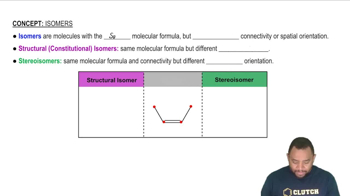
Structural Isomers

Structural isomers are compounds that have the same molecular formula but differ in the arrangement of atoms. This can include variations in the connectivity of the carbon skeleton or the functional groups attached. Understanding structural isomers is crucial for analyzing how different configurations can lead to distinct chemical properties and biological functions.
추천 영상:
가이드 코스
2:16
Isomers Concept 1

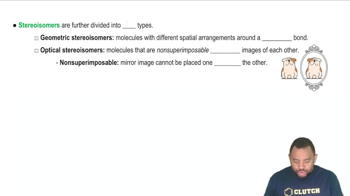
Stereoisomers

Stereoisomers are compounds that have the same molecular formula and connectivity but differ in the spatial arrangement of atoms. This category includes enantiomers and diastereomers. Recognizing stereoisomers is essential for understanding how molecules interact in biological systems, as the three-dimensional shape can significantly influence reactivity and function.
추천 영상:
가이드 코스
1:56
Stereoisomers Concept 2

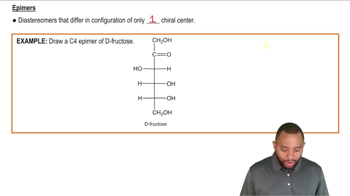
Epimers

Epimers are a specific type of diastereomer that differ in configuration at only one specific carbon atom. This distinction is important in carbohydrate chemistry, as epimers can have different biological activities and properties. Identifying epimers helps in understanding the structural diversity of sugars and their roles in metabolism.
추천 영상:
가이드 코스
1:26
D vs L Enantiomers Example 2