Ch.6 Carbohydrates Life's Sweet Molecules
Frost - General, Organic and Biological Chemistry 4th Edition
Frost4th EditionGeneral, Organic and Biological ChemistryISBN: 9780134988696당신이 사용하는 게 아니라요?교과서 변경
3장, 문제 80

The glycosidic bond in a disaccharide was determined to be α(1→6). Hydrolysis of the disaccharide produced one galactose and one fructose. Draw the structure of the disaccharide.

검증된 단계별 안내
1
Understand the glycosidic bond notation: The α (1→6) bond indicates that the glycosidic linkage connects the anomeric carbon (carbon 1) of one sugar to the carbon 6 of another sugar, and the bond is in the alpha configuration (the -OH group on the anomeric carbon is pointing downward relative to the ring).
Identify the monosaccharides involved: The problem states that hydrolysis of the disaccharide produces galactose and fructose. This means these two monosaccharides are linked via the α (1→6) glycosidic bond.
Draw the structure of galactose: Galactose is a hexose sugar with the formula C₆H₁₂O₆. It is typically drawn in its cyclic form as a pyranose ring. Ensure the anomeric carbon (carbon 1) has the -OH group in the alpha configuration (pointing downward).
Draw the structure of fructose: Fructose is a hexose sugar with the formula C₆H₁₂O₆. It is typically drawn in its cyclic form as a furanose ring. Identify carbon 6, which will be involved in the glycosidic bond.
Connect the two structures: Link the anomeric carbon (carbon 1) of galactose to carbon 6 of fructose using the α (1→6) glycosidic bond. Ensure the bond is drawn clearly to reflect the alpha configuration and the correct carbons involved in the linkage.

비슷한 문제에 대한 검증된 영상 답변:

이 영상 해법은 위 문제에 도움이 된다고 튜터들이 추천한 것입니다.
영상 길이:
7m

주요 개념

질문에 올바르게 답하기 위해 반드시 이해해야 하는 핵심 개념들은 다음과 같습니다.

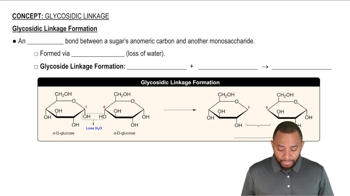
Glycosidic Bond

A glycosidic bond is a type of covalent bond that connects a carbohydrate (sugar) molecule to another group, which can also be a carbohydrate. In disaccharides, this bond forms between the anomeric carbon of one sugar and a hydroxyl group of another, determining the structure and properties of the resulting molecule. The notation α (1→6) indicates the specific carbons involved in the bond formation, influencing the disaccharide's characteristics.
추천 영상:
가이드 코스
1:44
Glycosidic Linkage Formation Concept 1

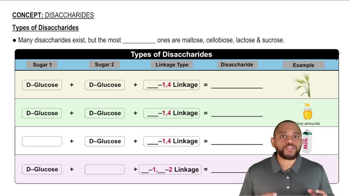
Disaccharide Structure

A disaccharide is a carbohydrate composed of two monosaccharide units linked by a glycosidic bond. The specific arrangement of these units and the type of glycosidic bond (e.g., α or β) determine the disaccharide's properties and how it is metabolized. In this case, the disaccharide formed from galactose and fructose is crucial for understanding its structure and function.
추천 영상:
가이드 코스
3:39
Types of Disaccharides Concept 1

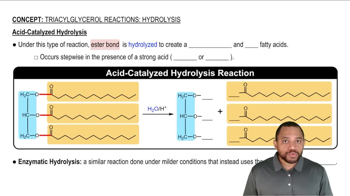
Hydrolysis Reaction

Hydrolysis is a chemical reaction that involves the breaking of a bond in a molecule using water. In the context of disaccharides, hydrolysis results in the separation of the two monosaccharide units, allowing for their individual identification. This reaction is essential for understanding how disaccharides are broken down in biological systems, providing energy and building blocks for more complex carbohydrates.
추천 영상:
가이드 코스
3:09
Triacylglycerol Reactions: Hydrolysis Concept 1