Ch.6 Chemical Reactions: Mole and Mass Relationships
McMurry - Fundamentals of General, Organic, and Biological Chemistry 8th Edition
McMurry8th EditionFundamentals of General, Organic, and Biological ChemistryISBN: 9780134015187당신이 사용하는 게 아니라요?교과서 변경
6장, 문제 8b

How many moles of NiCl2 can be formed in the reaction of 6.00 mol of Ni and 12.0 mol of HCl?
Ni(s) + HCl(aq) → NiCl2(aq) + H2(g)

검증된 단계별 안내
1
Write the balanced chemical equation for the reaction: Ni + 2HCl → NiCl₂ + H₂. This equation shows that 1 mole of Ni reacts with 2 moles of HCl to produce 1 mole of NiCl₂ and 1 mole of H₂.
Determine the limiting reactant by comparing the mole ratio of the reactants to the stoichiometric ratio in the balanced equation. From the equation, 1 mole of Ni requires 2 moles of HCl.
Calculate the amount of HCl required to react with 6.00 moles of Ni. Using the stoichiometric ratio, multiply the moles of Ni by the ratio of HCl to Ni: (6.00 mol Ni) × (2 mol HCl / 1 mol Ni).
Compare the calculated amount of HCl required to the amount of HCl available (12.0 mol). If the available HCl is greater than or equal to the required amount, Ni is the limiting reactant. Otherwise, HCl is the limiting reactant.
Using the limiting reactant, calculate the moles of NiCl₂ formed. If Ni is the limiting reactant, the moles of NiCl₂ formed will be equal to the moles of Ni (1:1 ratio from the balanced equation). If HCl is the limiting reactant, divide the moles of HCl by 2 (stoichiometric ratio) to find the moles of NiCl₂ formed.

비슷한 문제에 대한 검증된 영상 답변:

이 영상 해법은 위 문제에 도움이 된다고 튜터들이 추천한 것입니다.
영상 길이:
3m

주요 개념

질문에 올바르게 답하기 위해 반드시 이해해야 하는 핵심 개념들은 다음과 같습니다.

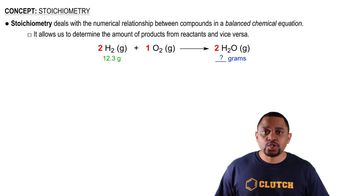
Stoichiometry

Stoichiometry is the branch of chemistry that deals with the quantitative relationships between the reactants and products in a chemical reaction. It allows us to calculate how much of each substance is needed or produced based on balanced chemical equations. Understanding stoichiometry is essential for determining the amounts of reactants and products involved in a reaction.
추천 영상:

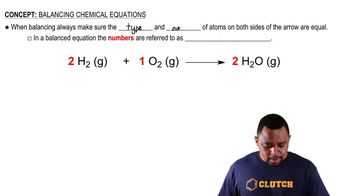
Balanced Chemical Equation

A balanced chemical equation represents a chemical reaction with equal numbers of each type of atom on both sides of the equation. It provides the mole ratios of reactants and products, which are crucial for stoichiometric calculations. For the reaction involving Ni and HCl to form NiCl2, the balanced equation will indicate how many moles of NiCl2 can be produced from the given amounts of Ni and HCl.
추천 영상:
가이드 코스
01:32
Balancing Chemical Equations (Simplified) Concept 1

Limiting Reactant

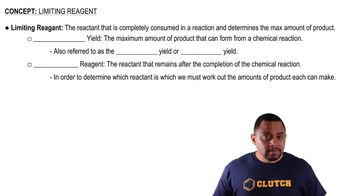
The limiting reactant is the substance that is completely consumed first in a chemical reaction, thus determining the maximum amount of product that can be formed. Identifying the limiting reactant is critical in stoichiometric calculations, as it dictates the extent of the reaction. In this case, knowing which reactant (Ni or HCl) limits the formation of NiCl2 will help calculate the moles of product formed.
추천 영상:
가이드 코스
01:30
Limiting Reagent