Ch.7 Chemical Reactions: Energy, Rate and Equilibrium
McMurry - Fundamentals of General, Organic, and Biological Chemistry 8th Edition
McMurry8th EditionFundamentals of General, Organic, and Biological ChemistryISBN: 9780134015187당신이 사용하는 게 아니라요?교과서 변경
7장, 문제 40a

The following reaction is used in the industrial synthesis of polyvinyl chloride (PVC) polymer:
Cl2(g) + H2C=CH2(g) → ClCH2CH2Cl(l) ∆H = –52 kcal/mol (–218 kJ/mol)
a. Is ∆S positive or negative for this process?

검증된 단계별 안내
1
Step 1: Begin by analyzing the reaction. The reactants are chlorine gas (Cl₂) and ethene (H₂C=CH₂), both in the gaseous state, while the product is 1,2-dichloroethane (ClCH₂CH₂Cl), which is in the liquid state. This phase change is important for determining the entropy change (∆S).
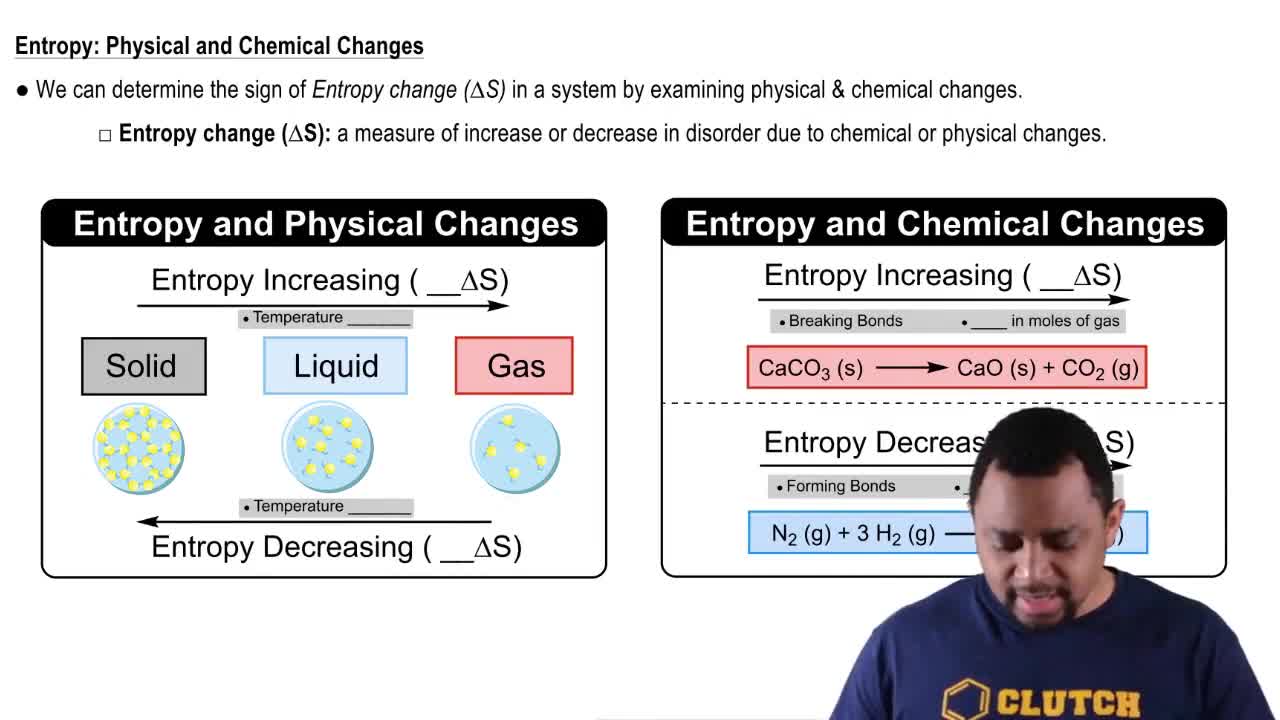
Step 2: Recall that entropy (S) is a measure of disorder or randomness in a system. Gases have higher entropy compared to liquids because gas particles are more disordered and have more freedom of movement.
Step 3: Observe that the reaction starts with two gaseous molecules (Cl₂ and H₂C=CH₂) and produces one liquid molecule (ClCH₂CH₂Cl). This indicates a decrease in the number of particles and a transition from a gaseous state to a liquid state, both of which typically result in a decrease in entropy.
Step 4: Consider the overall system. The reduction in the number of particles and the phase change from gas to liquid suggest that the system becomes more ordered, leading to a negative ∆S value.
Step 5: Conclude that ∆S for this process is negative because the reaction results in fewer particles and a transition to a more ordered liquid state, reducing the overall entropy of the system.

비슷한 문제에 대한 검증된 영상 답변:

이 영상 해법은 위 문제에 도움이 된다고 튜터들이 추천한 것입니다.
영상 길이:
2m

주요 개념

질문에 올바르게 답하기 위해 반드시 이해해야 하는 핵심 개념들은 다음과 같습니다.

Entropy (∆S)

Entropy, denoted as ∆S, is a measure of the disorder or randomness in a system. In chemical reactions, a positive ∆S indicates an increase in disorder, while a negative ∆S suggests a decrease in disorder. Understanding how the arrangement of molecules changes during a reaction is crucial for predicting the sign of ∆S.
추천 영상:
가이드 코스
03:22
Entropy (Simplified) Concept 2

Reaction Mechanism

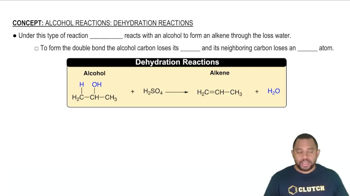
The reaction mechanism describes the step-by-step process by which reactants are converted into products. In the given reaction, the addition of chlorine to ethylene involves breaking and forming bonds, which can affect the molecular arrangement and thus the entropy. Analyzing the mechanism helps in determining how the reaction influences the system's disorder.
추천 영상:
가이드 코스
1:30
Alcohol Reactions: Dehydration Reactions Concept 1

Thermodynamics of Reactions

Thermodynamics provides the framework for understanding energy changes in chemical reactions, including enthalpy (∆H) and entropy (∆S). The relationship between these two properties is described by the Gibbs free energy equation (∆G = ∆H - T∆S). For the given reaction, knowing the enthalpy change helps infer the likely change in entropy, as exothermic reactions often lead to a decrease in disorder.
추천 영상:
가이드 코스
01:18
First Law of Thermodynamics