Ch.8 Gases, Liquids and Solids
McMurry - Fundamentals of General, Organic, and Biological Chemistry 8th Edition
McMurry8th EditionFundamentals of General, Organic, and Biological ChemistryISBN: 9780134015187당신이 사용하는 게 아니라요?교과서 변경
8장, 문제 20

Determine the percent composition of air in the lungs from the following composition in partial pressures: PN2= 573 mmHg, PO2 = 100 mmHg, PCO2 = 40 mmHg, and PH2O = 47 mmHg; all at 37 °C and 1 atm pressure.

검증된 단계별 안내
1
Step 1: Understand the concept of percent composition. Percent composition is calculated as the ratio of the partial pressure of a specific gas to the total pressure, multiplied by 100 to express it as a percentage.
Step 2: Calculate the total pressure in the lungs by summing up the partial pressures of all the gases: PN2, PO2, PCO2, and PH2O. Use the formula: Ptotal = PN2 + PO2 + PCO2 + PH2O.
Step 3: For each gas, calculate its percent composition using the formula: %composition = (Pgas / Ptotal) × 100. Substitute the partial pressure of each gas and the total pressure into this formula.
Step 4: Perform the calculation for each gas: nitrogen (N2), oxygen (O2), carbon dioxide (CO2), and water vapor (H2O). Ensure that the units of pressure are consistent throughout the calculation.
Step 5: Summarize the percent composition of each gas in the lungs. Verify that the sum of all percentages is approximately 100%, accounting for rounding errors.

비슷한 문제에 대한 검증된 영상 답변:

이 영상 해법은 위 문제에 도움이 된다고 튜터들이 추천한 것입니다.
영상 길이:
4m

주요 개념

질문에 올바르게 답하기 위해 반드시 이해해야 하는 핵심 개념들은 다음과 같습니다.

Partial Pressure

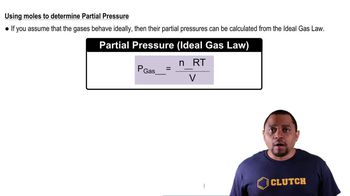
Partial pressure refers to the pressure exerted by a single gas in a mixture of gases. It is a crucial concept in understanding gas behavior in the lungs, as each gas contributes to the total pressure of the mixture. In this context, the partial pressures of nitrogen, oxygen, carbon dioxide, and water vapor are used to determine their respective contributions to the overall composition of air in the lungs.
추천 영상:
가이드 코스
00:48
Dalton's Law: Partial Pressure (Simplified) Concept 2

Percent Composition

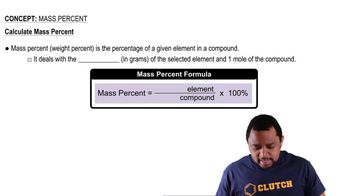
Percent composition is a way to express the concentration of a component in a mixture as a percentage of the total. In the context of gases in the lungs, it is calculated by dividing the partial pressure of each gas by the total pressure and multiplying by 100. This allows for a clear understanding of how much of each gas is present relative to the total pressure of the air mixture.
추천 영상:
가이드 코스
00:38
Mass Percent Concept

Total Pressure

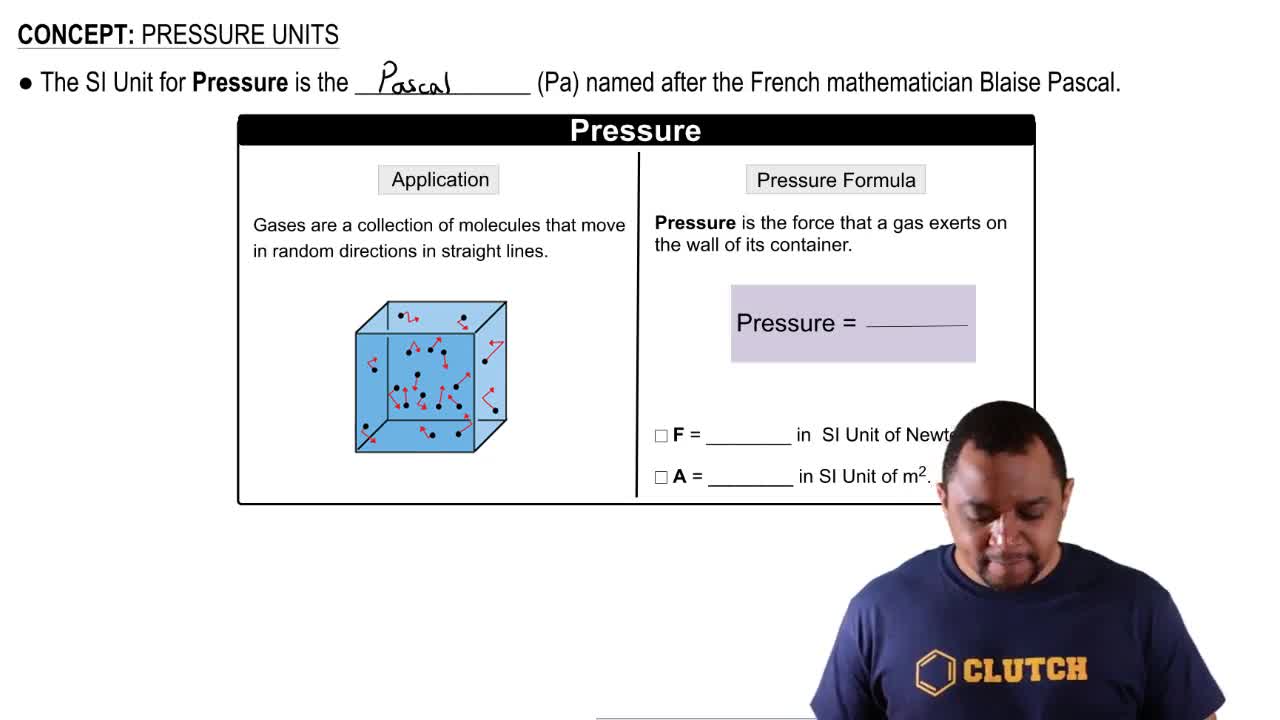
Total pressure is the sum of the partial pressures of all gases in a mixture. In this scenario, the total pressure is given as 1 atm, which is equivalent to 760 mmHg. To find the percent composition of air in the lungs, one must first calculate the total pressure from the provided partial pressures and then use this value to determine the individual gas contributions.
추천 영상:
가이드 코스
01:15
Pressure Units Concept 1