Ch.17 Carboxylic Acids and Their Derivatives
McMurry - Fundamentals of General, Organic, and Biological Chemistry 8th Edition
McMurry8th EditionFundamentals of General, Organic, and Biological ChemistryISBN: 9780134015187당신이 사용하는 게 아니라요?교과서 변경
17장, 문제 67b

Household soap is a mixture of the sodium or potassium salts of long-chain carboxylic acids that arise from saponification of animal fat.
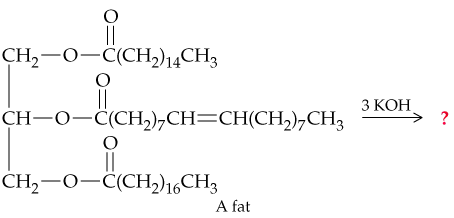
b. Draw the structures of the soap molecules produced in the following reaction:

검증된 단계별 안내
1
Identify the reactants in the saponification reaction. Saponification involves the reaction of a triglyceride (animal fat) with a strong base, such as sodium hydroxide (NaOH) or potassium hydroxide (KOH). The triglyceride consists of a glycerol backbone attached to three long-chain fatty acid esters.
Understand the reaction mechanism. In saponification, the ester bonds in the triglyceride are hydrolyzed by the strong base, resulting in the formation of glycerol (a byproduct) and the sodium or potassium salts of the fatty acids (soap molecules).
Determine the structure of the soap molecules. The soap molecules are the deprotonated forms of the fatty acids, where the carboxylic acid group (-COOH) is converted into a carboxylate ion (-COO⁻) and paired with a sodium (Na⁺) or potassium (K⁺) ion.
Draw the structure of the soap molecules. For each fatty acid chain, replace the ester bond with a carboxylate group (-COO⁻) at the end of the chain. Attach the sodium (Na⁺) or potassium (K⁺) ion to the carboxylate group to complete the soap molecule structure.
Verify the products. Ensure that the reaction produces three soap molecules (one for each fatty acid chain in the triglyceride) and one glycerol molecule. Confirm that the structures are consistent with the reactants and the saponification process.

비슷한 문제에 대한 검증된 영상 답변:

이 영상 해법은 위 문제에 도움이 된다고 튜터들이 추천한 것입니다.

주요 개념

질문에 올바르게 답하기 위해 반드시 이해해야 하는 핵심 개념들은 다음과 같습니다.

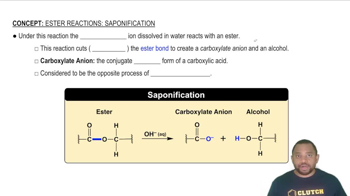
Saponification

Saponification is a chemical reaction that occurs when fats or oils react with an alkali, typically sodium hydroxide or potassium hydroxide, to produce soap and glycerol. This process involves the hydrolysis of triglycerides, breaking them down into fatty acid salts and glycerin. Understanding saponification is crucial for grasping how soap molecules are formed from animal fats.
추천 영상:
가이드 코스
1:25
Ester Reactions: Saponification Concept 1

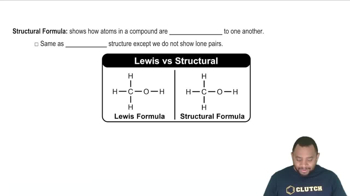
Soap Structure

Soap molecules consist of long hydrocarbon chains with a polar carboxylate group at one end. The hydrocarbon tail is hydrophobic (water-repelling), while the carboxylate head is hydrophilic (water-attracting). This dual nature allows soap to emulsify oils and fats in water, making it effective for cleaning. Drawing the structure involves illustrating both the hydrophobic tail and the hydrophilic head.
추천 영상:
가이드 코스
1:01
Structural Formula Concept 2

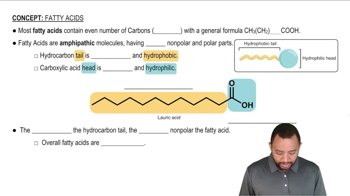
Fatty Acids

Fatty acids are carboxylic acids with long hydrocarbon chains, which can be saturated or unsaturated. They are the building blocks of lipids and are released during the saponification process. The specific fatty acids present in the soap depend on the type of fat used, influencing the soap's properties such as lathering ability and moisturizing effects.
추천 영상:
가이드 코스
2:00
Fatty Acids Concept 1