
Ch.17 Carboxylic Acids and Their Derivatives
McMurry - Fundamentals of General, Organic, and Biological Chemistry 8th Edition
McMurry8th EditionFundamentals of General, Organic, and Biological ChemistryISBN: 9780134015187당신이 사용하는 게 아니라요?교과서 변경
17장, 문제 24a

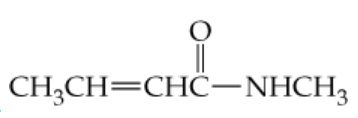
What carboxylic acids and amines result from hydrolysis of the following amides?
a. Chemical structure of an amide with a double bond, showing the molecular formula and functional groups.

검증된 단계별 안내
1
Identify the functional groups in the given amide structure. Amides consist of a carbonyl group (C=O) directly bonded to a nitrogen atom (N). The hydrolysis of an amide involves breaking the bond between the carbonyl carbon and the nitrogen atom.
Understand the hydrolysis reaction. Hydrolysis of an amide can occur under acidic or basic conditions. In acidic hydrolysis, the amide reacts with water and an acid catalyst to produce a carboxylic acid and an amine salt. In basic hydrolysis, the amide reacts with a base to produce a carboxylate ion and a free amine.
Determine the products of hydrolysis. The carbonyl carbon of the amide becomes part of the carboxylic acid (or carboxylate ion in basic hydrolysis), while the nitrogen atom and its attached groups form the amine (or amine salt in acidic hydrolysis).
Examine the specific structure of the given amide (from the image) to identify the R groups attached to the carbonyl carbon and the nitrogen atom. These R groups will determine the specific carboxylic acid and amine produced.
Write the balanced chemical equation for the hydrolysis reaction, showing the amide as the reactant and the carboxylic acid and amine (or their respective forms under acidic/basic conditions) as the products. Use the identified R groups to complete the equation.

비슷한 문제에 대한 검증된 영상 답변:

이 영상 해법은 위 문제에 도움이 된다고 튜터들이 추천한 것입니다.
영상 길이:
2m

주요 개념

질문에 올바르게 답하기 위해 반드시 이해해야 하는 핵심 개념들은 다음과 같습니다.

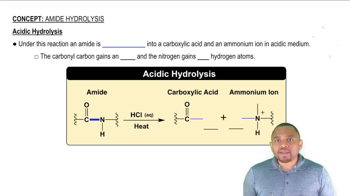
Hydrolysis of Amides

Hydrolysis of amides is a chemical reaction where an amide reacts with water, resulting in the formation of a carboxylic acid and an amine. This process typically requires an acid or base catalyst to facilitate the reaction. Understanding the structure of the amide is crucial, as it determines the specific carboxylic acid and amine produced.
추천 영상:
가이드 코스
1:12
Acidic Hydrolysis Concept 1

Carboxylic Acids

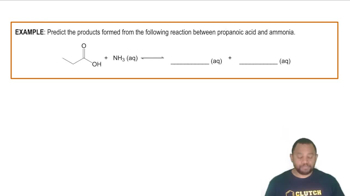
Carboxylic acids are organic compounds characterized by the presence of a carboxyl group (-COOH). They are known for their acidic properties and can be derived from the hydrolysis of amides. The specific carboxylic acid formed during hydrolysis depends on the alkyl or aryl group attached to the nitrogen in the amide.
추천 영상:
가이드 코스
1:09
Carboxylic Acid Reactions Example 1

Amines

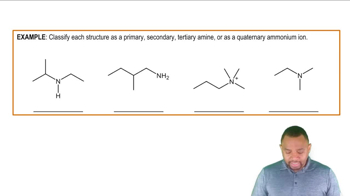
Amines are organic compounds derived from ammonia by replacing one or more hydrogen atoms with alkyl or aryl groups. They can be classified as primary, secondary, or tertiary based on the number of carbon-containing groups attached to the nitrogen atom. The type of amine produced during the hydrolysis of an amide is influenced by the structure of the original amide.
추천 영상:
가이드 코스
0:54
Amine Classification Example 1