Ch.18 Amino Acids and Proteins
McMurry - Fundamentals of General, Organic, and Biological Chemistry 8th Edition
McMurry8th EditionFundamentals of General, Organic, and Biological ChemistryISBN: 9780134015187당신이 사용하는 게 아니라요?교과서 변경
18장, 문제 15

Valine is an amino acid with a nonpolar side chain, and serine is an amino acid with a polar side chain. Draw the two dipeptides that can be formed by these two amino acids. Identify the peptide bond.

검증된 단계별 안내
1
Step 1: Understand the structure of the amino acids. Valine has a nonpolar side chain (isopropyl group), and serine has a polar side chain (hydroxymethyl group). Both amino acids have an amino group (-NH₂) and a carboxyl group (-COOH) attached to the central carbon (α-carbon).
Step 2: Recall how a peptide bond is formed. A peptide bond is a covalent bond formed between the carboxyl group of one amino acid and the amino group of another amino acid through a condensation reaction, which releases a molecule of water (H₂O).
Step 3: Draw the first dipeptide where valine is the N-terminal amino acid (the amino acid with the free -NH₂ group). Connect the carboxyl group of valine to the amino group of serine, forming the peptide bond. Label the peptide bond as the C-N bond formed during the reaction.
Step 4: Draw the second dipeptide where serine is the N-terminal amino acid. Connect the carboxyl group of serine to the amino group of valine, forming the peptide bond. Again, label the peptide bond as the C-N bond formed during the reaction.
Step 5: Verify the structures of both dipeptides. Ensure that the peptide bonds are correctly formed, the side chains of valine and serine are intact, and the terminal groups (free -NH₂ and -COOH) are correctly positioned for each dipeptide.

비슷한 문제에 대한 검증된 영상 답변:

이 영상 해법은 위 문제에 도움이 된다고 튜터들이 추천한 것입니다.

주요 개념

질문에 올바르게 답하기 위해 반드시 이해해야 하는 핵심 개념들은 다음과 같습니다.

Amino Acids

Amino acids are organic compounds that serve as the building blocks of proteins. Each amino acid consists of a central carbon atom, an amino group, a carboxyl group, a hydrogen atom, and a distinctive side chain (R group) that determines its properties. Valine, with a nonpolar side chain, is hydrophobic, while serine, with a polar side chain, is hydrophilic, influencing their interactions in proteins.
추천 영상:
가이드 코스
3:03
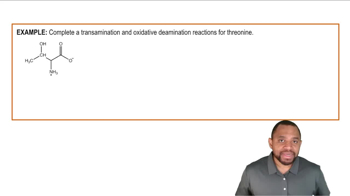
Amino Acid Catabolism: Amino Group Example 2

Dipeptides

Dipeptides are molecules formed when two amino acids are linked together by a peptide bond. This bond is created through a dehydration synthesis reaction, where a water molecule is released as the carboxyl group of one amino acid reacts with the amino group of another. The resulting dipeptide retains the characteristics of both amino acids, influencing its overall properties and functions.
추천 영상:
가이드 코스
2:27
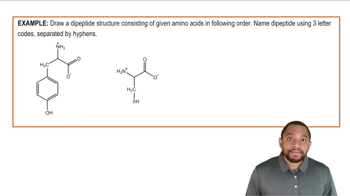
Peptides Example 2

Peptide Bond

A peptide bond is a covalent bond that links amino acids together in a protein. It forms between the carboxyl group of one amino acid and the amino group of another, resulting in the release of a water molecule. This bond is crucial for the structure and function of proteins, as it determines the sequence and arrangement of amino acids in polypeptides.
추천 영상:
가이드 코스
1:24
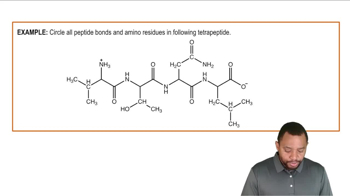
Peptides Example 1