Ch.21 The Generation of Biochemical Energy
McMurry - Fundamentals of General, Organic, and Biological Chemistry 8th Edition
McMurry8th EditionFundamentals of General, Organic, and Biological ChemistryISBN: 9780134015187당신이 사용하는 게 아니라요?교과서 변경
21장, 문제 22

For the first step in fatty acid catabolism, we say that ATP is used to “drive” the reaction that links the fatty acid with coenzyme-A. Without ATP hydrolysis, would you predict that the linking of fatty acid to coenzyme-A would be ­exergonic or endergonic? In fatty acid CoA synthesis, the hydrolysis of the ATP portion is based on what major strategy of metabolism?

검증된 단계별 안내
1
Understand the context: Fatty acid catabolism begins with the activation of the fatty acid by linking it to coenzyme-A (CoA). This reaction requires energy input, which is provided by ATP hydrolysis. The question asks whether this reaction would be exergonic (releases energy) or endergonic (requires energy) without ATP hydrolysis.
Step 1: Recall the definition of endergonic and exergonic reactions. Endergonic reactions require an input of energy to proceed, while exergonic reactions release energy and occur spontaneously. Linking a fatty acid to CoA involves forming a high-energy thioester bond, which is not energetically favorable on its own.
Step 2: Analyze the role of ATP hydrolysis. ATP hydrolysis provides the necessary energy to drive the reaction forward. The hydrolysis of ATP to ADP and inorganic phosphate (Pi) is highly exergonic, and this energy is coupled to the otherwise endergonic reaction of fatty acid-CoA formation.
Step 3: Predict the reaction's nature without ATP hydrolysis. Without the energy provided by ATP hydrolysis, the reaction linking fatty acid to CoA would be endergonic because forming the high-energy thioester bond requires an input of energy.
Step 4: Relate this to a major strategy of metabolism. The hydrolysis of ATP in this process is an example of energy coupling, a fundamental strategy in metabolism. Energy coupling uses the energy released from an exergonic reaction (like ATP hydrolysis) to drive an endergonic reaction (like fatty acid-CoA synthesis).

비슷한 문제에 대한 검증된 영상 답변:

이 영상 해법은 위 문제에 도움이 된다고 튜터들이 추천한 것입니다.
영상 길이:
5m

주요 개념

질문에 올바르게 답하기 위해 반드시 이해해야 하는 핵심 개념들은 다음과 같습니다.

Exergonic vs. Endergonic Reactions

Exergonic reactions release energy and occur spontaneously, while endergonic reactions require an input of energy to proceed. In the context of fatty acid catabolism, the linking of fatty acids to coenzyme-A is typically endergonic, meaning it needs energy, which is provided by ATP hydrolysis.
추천 영상:
가이드 코스
3:33
Enantiomers vs Diastereomers Concept 1

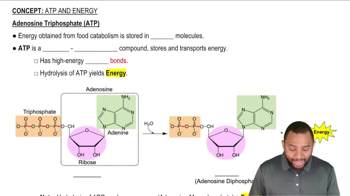
ATP Hydrolysis

ATP hydrolysis is the process of breaking down adenosine triphosphate (ATP) into adenosine diphosphate (ADP) and inorganic phosphate, releasing energy. This energy is crucial for driving endergonic reactions, such as the activation of fatty acids, making it a key player in metabolic pathways.
추천 영상:
가이드 코스
2:20
Adenosine Triphosphate (ATP) Concept 2

Metabolic Strategies

In metabolism, one major strategy is the coupling of exergonic and endergonic reactions. By using the energy released from ATP hydrolysis, cells can drive unfavorable reactions forward, such as the synthesis of fatty acyl-CoA, thereby facilitating essential biochemical processes.
추천 영상:
가이드 코스
0:52
Metabolic Pathways Concept 2