Ch.21 The Generation of Biochemical Energy
McMurry - Fundamentals of General, Organic, and Biological Chemistry 8th Edition
McMurry8th EditionFundamentals of General, Organic, and Biological ChemistryISBN: 9780134015187당신이 사용하는 게 아니라요?교과서 변경
21장, 문제 55c

Look at the eight steps of the citric acid cycle (Figure 21.8) and answer the following questions:
c. Which step or steps involve a hydration reaction?

검증된 단계별 안내
1
Step 1: Understand the concept of a hydration reaction. A hydration reaction involves the addition of a water molecule (H₂O) to a compound, typically resulting in the formation of an alcohol or other functional group.
Step 2: Review the eight steps of the citric acid cycle (also known as the Krebs cycle or TCA cycle) in Figure 21.8. Pay close attention to the chemical transformations occurring in each step.
Step 3: Identify the step(s) where a water molecule is added to a substrate. Look for reactions where the reactant gains a hydroxyl group (-OH) and a hydrogen atom (H) from water.
Step 4: Specifically, focus on the conversion of fumarate to malate. This step involves the addition of water across the double bond of fumarate, forming malate. This is a classic example of a hydration reaction.
Step 5: Confirm that no other steps in the citric acid cycle involve the addition of water in the same manner. Ensure that you understand the role of enzymes like fumarase, which catalyzes the hydration reaction in the cycle.

비슷한 문제에 대한 검증된 영상 답변:

이 영상 해법은 위 문제에 도움이 된다고 튜터들이 추천한 것입니다.
영상 길이:
2m

주요 개념

질문에 올바르게 답하기 위해 반드시 이해해야 하는 핵심 개념들은 다음과 같습니다.

Citric Acid Cycle

The citric acid cycle, also known as the Krebs cycle, is a series of enzymatic reactions that occur in the mitochondria, playing a crucial role in cellular respiration. It involves the oxidation of acetyl-CoA to produce energy in the form of ATP, NADH, and FADH2, while also generating carbon dioxide as a waste product. Understanding this cycle is essential for identifying specific reactions, such as hydration, that contribute to metabolic processes.
추천 영상:
가이드 코스
2:31
Citric Acid Cycle Summary Concept 12

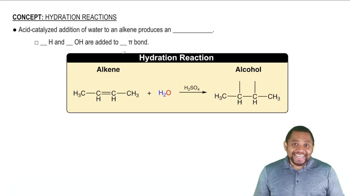
Hydration Reaction

A hydration reaction is a chemical process where a water molecule is added to a substance, often resulting in the formation of a new compound. In the context of the citric acid cycle, hydration reactions are important for the conversion of certain intermediates, facilitating the transformation of substrates and the continuation of the cycle. Recognizing these reactions helps in pinpointing specific steps that involve the addition of water.
추천 영상:
가이드 코스
1:25
Symmetric Alkene Hydration Concept 1

Enzymatic Reactions

Enzymatic reactions are biochemical processes catalyzed by enzymes, which are proteins that speed up chemical reactions without being consumed in the process. In the citric acid cycle, various enzymes facilitate each step, including those that involve hydration. Understanding the role of enzymes is crucial for identifying how specific reactions, such as hydration, are carried out and regulated within the cycle.
추천 영상:
가이드 코스
3:09
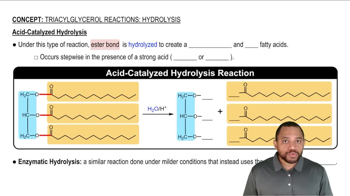
Triacylglycerol Reactions: Hydrolysis Concept 1