Ch.21 The Generation of Biochemical Energy
McMurry - Fundamentals of General, Organic, and Biological Chemistry 8th Edition
McMurry8th EditionFundamentals of General, Organic, and Biological ChemistryISBN: 9780134015187당신이 사용하는 게 아니라요?교과서 변경
21장, 문제 8

The hydrolysis of acetyl phosphate to give acetate and hydrogen phosphate ion has ∆G = -10.3 kcal/mol (-43.1 kJ/mol). Combine the equations and ∆G values to determine whether coupling of this reaction with phosphorylation of ADP to produce ATP is favorable. (You need give only compound names or abbreviations in the equations.)

검증된 단계별 안내
1
Write the two reactions involved in the problem. The first reaction is the hydrolysis of acetyl phosphate: Acetyl phosphate → Acetate + HPO₄²⁻ (∆G = -10.3 kcal/mol). The second reaction is the phosphorylation of ADP to produce ATP: ADP + HPO₄²⁻ → ATP + H₂O (∆G = +7.3 kcal/mol).
Combine the two reactions. To do this, add the reactants and products of both reactions, canceling out any species that appear on both sides of the equation. The combined reaction will be: Acetyl phosphate + ADP → Acetate + ATP.
Add the ∆G values of the two reactions to determine the overall ∆G for the combined reaction. Use the equation: ∆G_combined = ∆G₁ + ∆G₂, where ∆G₁ is the ∆G for the hydrolysis of acetyl phosphate (-10.3 kcal/mol) and ∆G₂ is the ∆G for the phosphorylation of ADP (+7.3 kcal/mol).
Interpret the sign of the overall ∆G. If the combined ∆G is negative, the coupling of the reactions is thermodynamically favorable. If it is positive, the coupling is not favorable.
Conclude whether the coupling of the hydrolysis of acetyl phosphate with the phosphorylation of ADP to produce ATP is favorable based on the calculated overall ∆G.

비슷한 문제에 대한 검증된 영상 답변:

이 영상 해법은 위 문제에 도움이 된다고 튜터들이 추천한 것입니다.
영상 길이:
5m

주요 개념

질문에 올바르게 답하기 위해 반드시 이해해야 하는 핵심 개념들은 다음과 같습니다.

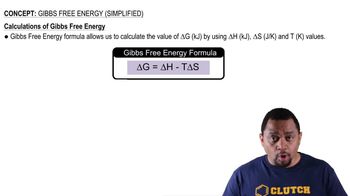
Gibbs Free Energy (∆G)

Gibbs Free Energy (∆G) is a thermodynamic potential that measures the maximum reversible work obtainable from a thermodynamic system at constant temperature and pressure. A negative ∆G indicates that a reaction is spontaneous and can occur without external energy input. In the context of biochemical reactions, it helps predict whether a reaction will proceed in the forward direction under standard conditions.
추천 영상:
가이드 코스
01:04
Gibbs Free Energy (Simplified) Concept 3

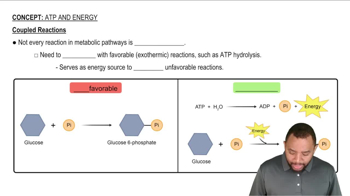
Coupled Reactions

Coupled reactions involve linking an energetically unfavorable reaction with a favorable one, allowing the overall process to proceed. In biochemistry, this often occurs when the energy released from a spontaneous reaction, such as the hydrolysis of ATP, is used to drive a non-spontaneous reaction. This principle is crucial for cellular processes, as it enables the synthesis of ATP from ADP and inorganic phosphate, despite the unfavorable nature of the phosphorylation reaction alone.
추천 영상:
가이드 코스
1:46
Coupled Reactions Concept 3

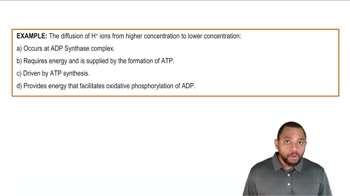
Phosphorylation of ADP

Phosphorylation of ADP to produce ATP is a key biochemical reaction that stores energy in the form of high-energy phosphate bonds. This process is typically coupled with exergonic reactions, such as the hydrolysis of acetyl phosphate, to make it energetically favorable. Understanding the energetics of this reaction is essential for grasping how cells manage energy transfer and storage during metabolic processes.
추천 영상:
가이드 코스
1:23
Oxidative Phosphorylation Example 1