Ch.24 Lipid Metabolism
McMurry - Fundamentals of General, Organic, and Biological Chemistry 8th Edition
McMurry8th EditionFundamentals of General, Organic, and Biological ChemistryISBN: 9780134015187당신이 사용하는 게 아니라요?교과서 변경
24장, 문제 5a

How many molecules of acetyl-CoA are produced by catabolism of the following fatty acids, and how many β oxidations are needed?
a. Palmitic acid, CH3(CH2)14COOH

검증된 단계별 안내
1
Step 1: Understand the structure of the fatty acid. Palmitic acid has the formula CH₃(CH₂)₁₄COOH. This means it has a total of 16 carbon atoms (1 from CH₃, 14 from CH₂ groups, and 1 from the COOH group).
Step 2: Recall the process of ß-oxidation. Each cycle of ß-oxidation removes a 2-carbon acetyl group from the fatty acid chain, which is converted into acetyl-CoA. The number of ß-oxidation cycles required is one less than the number of acetyl-CoA molecules produced.
Step 3: Determine the number of acetyl-CoA molecules. Since each acetyl-CoA contains 2 carbons, divide the total number of carbons in palmitic acid (16) by 2. This gives the total number of acetyl-CoA molecules produced.
Step 4: Calculate the number of ß-oxidation cycles. Subtract 1 from the number of acetyl-CoA molecules calculated in Step 3. This is because the final 2-carbon unit does not require an additional ß-oxidation cycle to be released.
Step 5: Summarize the results. The number of acetyl-CoA molecules produced and the number of ß-oxidation cycles required can now be determined based on the calculations in Steps 3 and 4.

비슷한 문제에 대한 검증된 영상 답변:

이 영상 해법은 위 문제에 도움이 된다고 튜터들이 추천한 것입니다.
영상 길이:
1m

주요 개념

질문에 올바르게 답하기 위해 반드시 이해해야 하는 핵심 개념들은 다음과 같습니다.

Fatty Acid Catabolism

Fatty acid catabolism refers to the metabolic process by which fatty acids are broken down to produce energy. This process primarily occurs in the mitochondria through a series of reactions known as beta-oxidation, where fatty acids are converted into acetyl-CoA units, which then enter the citric acid cycle for further energy production.
추천 영상:
가이드 코스
2:00
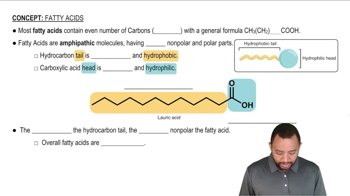
Fatty Acids Concept 1

Beta-Oxidation

Beta-oxidation is the biochemical pathway that breaks down fatty acids into acetyl-CoA. Each cycle of beta-oxidation shortens the fatty acid chain by two carbon atoms, producing one molecule of acetyl-CoA and generating reducing equivalents in the form of NADH and FADH2, which are used in the electron transport chain to produce ATP.
추천 영상:
가이드 코스
02:32
Characteristics of Beta Particles

Acetyl-CoA Production

Acetyl-CoA is a central metabolite in energy metabolism, formed from the breakdown of carbohydrates, fats, and proteins. In the context of fatty acid catabolism, each molecule of palmitic acid (a 16-carbon fatty acid) undergoes seven cycles of beta-oxidation, yielding eight molecules of acetyl-CoA, which can then be utilized in the citric acid cycle for ATP production.
추천 영상:
가이드 코스
01:37
Solubility Product Constant (Ksp) Concept 2