Ch.1 Chemistry in Our Lives
Timberlake - Chemistry: An Introduction to General, Organic, and Biological Chemistry 13th Edition
Timberlake13th EditionChemistry: An Introduction to General, Organic, and Biological ChemistryISBN: 9780134421353당신이 사용하는 게 아니라요?교과서 변경
1장, 문제 28a

Which number in each of the following pairs is smaller?
a. 4.9 × 10⁻³ or 5.5 × 10⁻⁹

검증된 단계별 안내
1
Step 1: Understand the problem. You are comparing two numbers written in scientific notation: 4.9 × 10⁻³ and 5.5 × 10⁻⁹. The goal is to determine which number is smaller.
Step 2: Recall how scientific notation works. A number in scientific notation is expressed as \( a \times 10^n \), where \( a \) is the coefficient (a number between 1 and 10) and \( n \) is the exponent (which indicates the power of 10).
Step 3: Compare the exponents first. The exponent \( n \) determines the order of magnitude of the number. A smaller exponent (more negative) indicates a smaller number. In this case, \( 10^{-3} \) is larger than \( 10^{-9} \), so the number with \( 10^{-9} \) will be smaller.
Step 4: If the exponents were the same, you would compare the coefficients (\( a \)). However, since the exponents are different here, you do not need to compare the coefficients because the exponent already determines which number is smaller.
Step 5: Conclude that the number with the smaller exponent, 5.5 × 10⁻⁹, is the smaller number in this pair.

비슷한 문제에 대한 검증된 영상 답변:

이 영상 해법은 위 문제에 도움이 된다고 튜터들이 추천한 것입니다.
영상 길이:
1m

주요 개념

질문에 올바르게 답하기 위해 반드시 이해해야 하는 핵심 개념들은 다음과 같습니다.

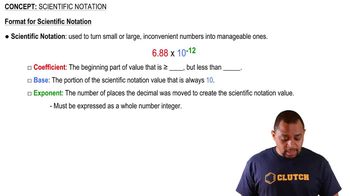
Scientific Notation

Scientific notation is a way of expressing numbers that are too large or too small to be conveniently written in decimal form. It is typically formatted as 'a x 10^n', where 'a' is a number greater than or equal to 1 and less than 10, and 'n' is an integer. This notation simplifies calculations and comparisons of very large or very small numbers.
추천 영상:
가이드 코스
01:41
Scientific Notation

Comparing Exponents

When comparing numbers in scientific notation, the first step is to compare the exponents of 10. The number with the larger exponent is the larger number. If the exponents are the same, then the coefficients (the 'a' values) are compared to determine which number is smaller or larger.
추천 영상:
가이드 코스
01:55
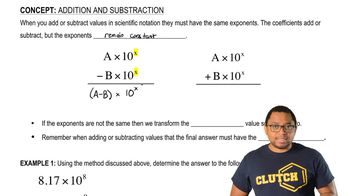
Addition and Subtraction Operations

Decimal Conversion

To compare numbers in scientific notation directly, converting them to decimal form can be helpful. For example, 4.9 x 10⁻³ equals 0.0049, and 5.5 x 10⁻⁹ equals 0.0000000055. This conversion allows for straightforward comparison of the two values by examining their decimal representations.
추천 영상:
가이드 코스
03:45
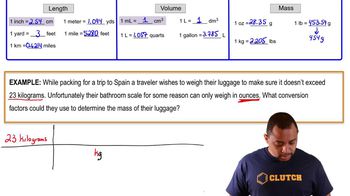
Conversion Factors (Simplified) Example 2