Ch.11 Introduction to Organic Chemistry: Hydrocarbons
Timberlake - Chemistry: An Introduction to General, Organic, and Biological Chemistry 13th Edition
Timberlake13th EditionChemistry: An Introduction to General, Organic, and Biological ChemistryISBN: 9780134421353당신이 사용하는 게 아니라요?교과서 변경
11장, 문제 64c

Give the name for the product from the hydrogenation of each of the following:
c. cyclopropene

검증된 단계별 안내
1
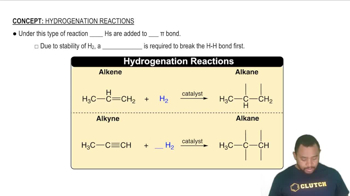
Identify the type of reaction: Hydrogenation is a chemical reaction where hydrogen (H₂) is added to a molecule, typically across a double or triple bond, converting unsaturated compounds into saturated ones.
Examine the structure of cyclopropene: Cyclopropene is a three-membered ring with one double bond. The double bond makes it an unsaturated compound.
Understand the effect of hydrogenation: During hydrogenation, the double bond in cyclopropene will be broken, and two hydrogen atoms will be added to the molecule, resulting in a saturated compound.
Determine the product: Breaking the double bond in cyclopropene and adding hydrogen atoms will convert it into cyclopropane, which is a saturated three-membered ring with only single bonds.
Name the product: The name of the product formed after hydrogenation of cyclopropene is cyclopropane.

비슷한 문제에 대한 검증된 영상 답변:

이 영상 해법은 위 문제에 도움이 된다고 튜터들이 추천한 것입니다.

주요 개념

질문에 올바르게 답하기 위해 반드시 이해해야 하는 핵심 개념들은 다음과 같습니다.

Hydrogenation

Hydrogenation is a chemical reaction that involves the addition of hydrogen (H2) to an unsaturated compound, typically an alkene or alkyne, to convert it into a saturated compound. This process is commonly used in organic chemistry to increase the stability of compounds by reducing the number of double or triple bonds. In the case of cyclopropene, hydrogenation will result in the formation of cyclopropane.
추천 영상:
가이드 코스
1:22
Hydrogenation Reactions Concept 1

Cyclopropene

Cyclopropene is a three-membered cyclic alkene characterized by a double bond between two of its carbon atoms. It is known for its ring strain due to the small size of the ring and the presence of the double bond, making it more reactive than larger cyclic alkenes. Understanding its structure is crucial for predicting the products of its hydrogenation.

Saturated vs. Unsaturated Compounds

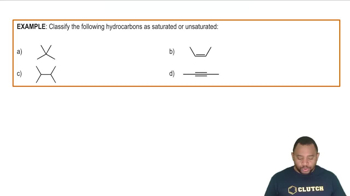
Saturated compounds contain only single bonds between carbon atoms, while unsaturated compounds contain one or more double or triple bonds. The hydrogenation process transforms unsaturated compounds into saturated ones by adding hydrogen atoms, thus increasing their stability and altering their chemical properties. Recognizing the difference between these types of compounds is essential for predicting the outcome of reactions like hydrogenation.
추천 영상:
가이드 코스
0:57
Saturated and Unsaturated Hydrocarbons Example 2