Ch.16 Amino Acids, Proteins, and Enzymes
Timberlake - Chemistry: An Introduction to General, Organic, and Biological Chemistry 13th Edition
Timberlake13th EditionChemistry: An Introduction to General, Organic, and Biological ChemistryISBN: 9780134421353당신이 사용하는 게 아니라요?교과서 변경
16장, 문제 24a

In myoglobin, about one-half of the 153 amino acids have nonpolar R groups.
a. Where would you expect those amino acids to be located in the tertiary structure?

검증된 단계별 안내
1
Understand the nature of nonpolar R groups: Nonpolar R groups are hydrophobic, meaning they tend to avoid water and prefer to interact with other nonpolar molecules or regions.
Recall the structure of myoglobin: Myoglobin is a globular protein with a tertiary structure, meaning it folds into a compact, three-dimensional shape. This folding is influenced by the interactions of amino acid side chains with their environment.
Consider the environment of the protein: In an aqueous (water-based) environment, hydrophobic (nonpolar) amino acids tend to cluster together in the interior of the protein to avoid contact with water. This is known as the hydrophobic effect.
Predict the location of nonpolar amino acids: Based on the hydrophobic effect, the nonpolar amino acids in myoglobin are most likely located in the interior of the protein, where they are shielded from the surrounding water.
Relate this to protein stability: The clustering of nonpolar amino acids in the interior contributes to the stability of the protein's tertiary structure by minimizing unfavorable interactions with water and maximizing favorable interactions among nonpolar groups.

비슷한 문제에 대한 검증된 영상 답변:

이 영상 해법은 위 문제에 도움이 된다고 튜터들이 추천한 것입니다.
영상 길이:
3m

주요 개념

질문에 올바르게 답하기 위해 반드시 이해해야 하는 핵심 개념들은 다음과 같습니다.

Tertiary Structure of Proteins

The tertiary structure of a protein refers to its three-dimensional shape formed by the folding and interactions of its amino acid chains. This structure is stabilized by various interactions, including hydrogen bonds, ionic bonds, and hydrophobic interactions. Understanding the tertiary structure is crucial for predicting how proteins function and interact with other molecules.
추천 영상:
가이드 코스
2:07
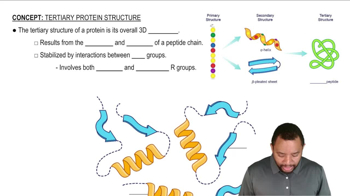
Tertiary Protein Structure Concept 1

Hydrophobic and Hydrophilic Interactions

Hydrophobic interactions occur when nonpolar R groups of amino acids cluster together to avoid contact with water, while hydrophilic interactions involve polar R groups that are attracted to water. In the context of protein structure, nonpolar amino acids are typically found in the interior of the protein, away from the aqueous environment, which helps maintain the protein's stability and functionality.
추천 영상:
가이드 코스
2:41
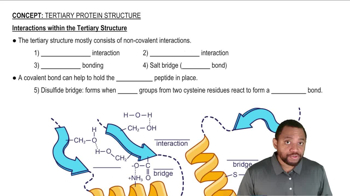
Interactions within the Tertiary Structure Concept 2

Amino Acid Properties

Amino acids are the building blocks of proteins, and their properties are determined by their R groups (side chains). Nonpolar R groups are hydrophobic and tend to be located in the interior of proteins, while polar or charged R groups are hydrophilic and often found on the surface. Recognizing these properties is essential for understanding how amino acids contribute to the overall structure and behavior of proteins.
추천 영상:
가이드 코스
3:03
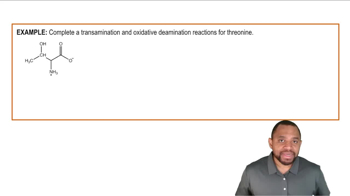
Amino Acid Catabolism: Amino Group Example 2