Ch.16 Amino Acids, Proteins, and Enzymes
Timberlake - Chemistry: An Introduction to General, Organic, and Biological Chemistry 13th Edition
Timberlake13th EditionChemistry: An Introduction to General, Organic, and Biological ChemistryISBN: 9780134421353당신이 사용하는 게 아니라요?교과서 변경
16장, 문제 34a

What is the name of the class of enzymes that would catalyze each of the following reactions?
a. addition of water to a double bond

검증된 단계별 안내
1
Understand the reaction: The addition of water to a double bond is a type of chemical reaction where a molecule of water (H₂O) is added across the double bond of an organic compound, typically resulting in the formation of an alcohol.
Recall the enzyme classification system: Enzymes are categorized into six major classes based on the type of reaction they catalyze. These classes include oxidoreductases, transferases, hydrolases, lyases, isomerases, and ligases.
Identify the relevant enzyme class: The addition of water to a double bond is typically catalyzed by enzymes known as 'hydrolases' or 'lyases,' depending on the specific mechanism. Hydrolases catalyze reactions involving water, while lyases often add or remove groups to form double bonds.
Focus on hydration reactions: Specifically, enzymes called 'hydratases' (a subclass of lyases) are responsible for catalyzing the addition of water to a double bond. These enzymes facilitate the hydration process without breaking the molecule into smaller fragments.
Conclude the enzyme class: Based on the reaction described, the class of enzymes that catalyze the addition of water to a double bond is 'lyases,' and more specifically, 'hydratases.'

비슷한 문제에 대한 검증된 영상 답변:

이 영상 해법은 위 문제에 도움이 된다고 튜터들이 추천한 것입니다.
영상 길이:
4m

주요 개념

질문에 올바르게 답하기 위해 반드시 이해해야 하는 핵심 개념들은 다음과 같습니다.

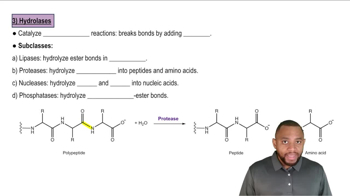
Hydrolases

Hydrolases are a class of enzymes that catalyze the hydrolysis of various bonds, including the addition of water to a double bond. This reaction typically involves breaking a chemical bond by the addition of water, resulting in the formation of two products. In the context of the question, hydrolases facilitate the conversion of alkenes into alcohols through this mechanism.
추천 영상:
가이드 코스
2:18
Hydrolases Concept 6

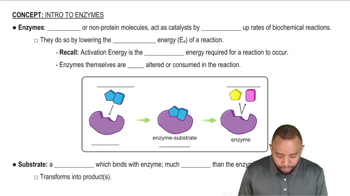
Enzyme Catalysis

Enzyme catalysis refers to the process by which enzymes accelerate chemical reactions. Enzymes lower the activation energy required for a reaction to occur, allowing it to proceed more quickly and efficiently. This is crucial in biological systems, where many reactions would occur too slowly without the action of enzymes.
추천 영상:
가이드 코스
2:14
Intro to Enzymes Concept 1

Substrate Specificity

Substrate specificity is the ability of an enzyme to selectively catalyze a reaction for a particular substrate or group of substrates. This specificity is determined by the enzyme's active site, which has a unique shape and chemical environment that fits only certain molecules. Understanding substrate specificity is essential for predicting the reactions that a given enzyme can catalyze.
추천 영상:
가이드 코스
01:37
Specific Gravity