Ch.18 Metabolic Pathways and ATP Production
Timberlake - Chemistry: An Introduction to General, Organic, and Biological Chemistry 13th Edition
Timberlake13th EditionChemistry: An Introduction to General, Organic, and Biological ChemistryISBN: 9780134421353당신이 사용하는 게 아니라요?교과서 변경
18장, 문제 35

What are the products from one turn of the citric acid cycle?

검증된 단계별 안내
1
The citric acid cycle, also known as the Krebs cycle or TCA cycle, is a series of chemical reactions that occur in the mitochondria of cells. It is a key metabolic pathway that generates energy through the oxidation of acetyl-CoA derived from carbohydrates, fats, and proteins.
In one turn of the citric acid cycle, the acetyl group from acetyl-CoA (2 carbons) combines with oxaloacetate (4 carbons) to form citrate (6 carbons). This initiates the cycle.
As the cycle progresses, citrate undergoes a series of enzymatic reactions, including decarboxylation and oxidation, which release two molecules of CO₂ and regenerate oxaloacetate to complete the cycle.
During these reactions, energy is captured in the form of high-energy molecules: 3 molecules of NADH, 1 molecule of FADH₂, and 1 molecule of GTP (or ATP, depending on the cell type). These molecules are used in the electron transport chain to produce ATP.
The products of one turn of the citric acid cycle are: 2 CO₂, 3 NADH, 1 FADH₂, 1 GTP (or ATP), and the regenerated oxaloacetate, which is ready to combine with another acetyl-CoA to start the cycle again.

비슷한 문제에 대한 검증된 영상 답변:

이 영상 해법은 위 문제에 도움이 된다고 튜터들이 추천한 것입니다.
영상 길이:
2m

주요 개념

질문에 올바르게 답하기 위해 반드시 이해해야 하는 핵심 개념들은 다음과 같습니다.

Citric Acid Cycle

The citric acid cycle, also known as the Krebs cycle or TCA cycle, is a series of chemical reactions used by all aerobic organisms to generate energy. It occurs in the mitochondria and is a key component of cellular respiration, where acetyl-CoA is oxidized to produce energy-rich molecules.
추천 영상:
가이드 코스
2:31
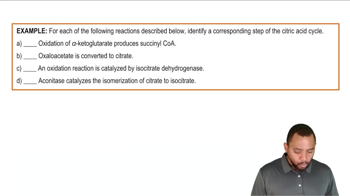
Citric Acid Cycle Summary Concept 12

Acetyl-CoA

Acetyl-CoA is a central metabolite in the citric acid cycle, formed from carbohydrates, fats, and proteins. It serves as the starting substrate for the cycle, combining with oxaloacetate to form citrate, which initiates the series of reactions that lead to energy production.
추천 영상:
가이드 코스
1:33
Phase B - Succinyl CoA Formation Example 2

Products of the Cycle

One turn of the citric acid cycle produces several key products: three NADH, one FADH2, one GTP (or ATP), and two carbon dioxide molecules. These products are crucial for the electron transport chain, where NADH and FADH2 are used to generate additional ATP through oxidative phosphorylation.
추천 영상:
가이드 코스
1:08
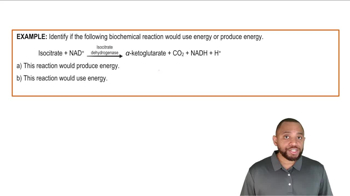
Energy Production In Biochemical Pathways Example 1