Ch.18 Metabolic Pathways and ATP Production
Timberlake - Chemistry: An Introduction to General, Organic, and Biological Chemistry 13th Edition
Timberlake13th EditionChemistry: An Introduction to General, Organic, and Biological ChemistryISBN: 9780134421353당신이 사용하는 게 아니라요?교과서 변경
18장, 문제 55c

What is the ATP energy yield associated with each of the following? 
c. 2 pyruvate → 2 acetyl CoA + 2CO2

검증된 단계별 안내
1
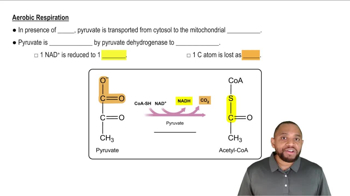
Understand the context: The conversion of pyruvate to acetyl CoA occurs during the transition step between glycolysis and the citric acid cycle. This process is catalyzed by the pyruvate dehydrogenase complex and involves the decarboxylation of pyruvate.
Identify the energy yield: During this reaction, each pyruvate molecule is oxidized to form one acetyl CoA molecule, releasing one molecule of CO₂. Additionally, one molecule of NAD⁺ is reduced to NADH per pyruvate. Since the problem involves 2 pyruvate molecules, 2 NADH molecules are produced.
Recall the ATP equivalence of NADH: In cellular respiration, each NADH molecule contributes to the production of ATP during oxidative phosphorylation. Typically, one NADH molecule yields approximately 2.5 ATP molecules.
Calculate the total ATP yield: Multiply the number of NADH molecules produced (2 NADH) by the ATP yield per NADH (2.5 ATP). This gives the total ATP yield associated with the conversion of 2 pyruvate to 2 acetyl CoA.
Summarize the process: The ATP energy yield from this reaction is derived entirely from the NADH molecules produced during the oxidation of pyruvate. No direct ATP is generated in this step, but the NADH contributes to ATP production later in the electron transport chain.

비슷한 문제에 대한 검증된 영상 답변:

이 영상 해법은 위 문제에 도움이 된다고 튜터들이 추천한 것입니다.
영상 길이:
1m

주요 개념

질문에 올바르게 답하기 위해 반드시 이해해야 하는 핵심 개념들은 다음과 같습니다.

ATP Yield in Cellular Respiration

ATP yield refers to the amount of adenosine triphosphate (ATP) produced during cellular respiration processes. In the conversion of pyruvate to acetyl CoA, which occurs in the mitochondria, each pyruvate molecule generates one molecule of NADH, contributing to the overall ATP production through oxidative phosphorylation.
추천 영상:

Pyruvate Decarboxylation

Pyruvate decarboxylation is the process where pyruvate, produced from glycolysis, is converted into acetyl CoA. This reaction releases carbon dioxide (CO₂) and is catalyzed by the pyruvate dehydrogenase complex, playing a crucial role in linking glycolysis to the citric acid cycle.
추천 영상:
가이드 코스
1:38
Pyruvate Oxidation Concept 2

NADH and ATP Production

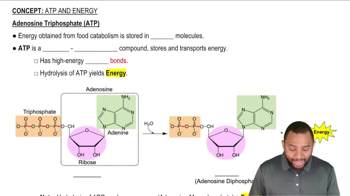
NADH is a key electron carrier in cellular respiration, generated during glycolysis and the conversion of pyruvate to acetyl CoA. Each NADH can yield approximately 2.5 ATP when oxidized in the electron transport chain, thus significantly contributing to the total ATP yield from the metabolism of glucose.
추천 영상:
가이드 코스
2:20
Adenosine Triphosphate (ATP) Concept 2