Ch.3 Matter and Energy
Timberlake - Chemistry: An Introduction to General, Organic, and Biological Chemistry 13th Edition
Timberlake13th EditionChemistry: An Introduction to General, Organic, and Biological ChemistryISBN: 9780134421353당신이 사용하는 게 아니라요?교과서 변경
3장, 문제 98

A 45-g piece of ice at 0.0 °C is added to a sample of water at 8.0 °C. All of the ice melts and the temperature of the water decreases to 0.0 °C. How many grams of water were in the sample?

검증된 단계별 안내
1
Step 1: Identify the energy required to melt the ice. Use the formula \( q = m \cdot \Delta H_{fus} \), where \( m \) is the mass of the ice (45 g) and \( \Delta H_{fus} \) is the heat of fusion for water (334 J/g). This will give the energy needed to convert the ice at 0.0 °C to liquid water at 0.0 °C.
Step 2: Determine the energy lost by the water sample as it cools from 8.0 °C to 0.0 °C. Use the formula \( q = m \cdot c \cdot \Delta T \), where \( m \) is the mass of the water sample (unknown), \( c \) is the specific heat capacity of water (4.18 J/g·°C), and \( \Delta T \) is the temperature change (8.0 °C - 0.0 °C).
Step 3: Set up an energy balance equation. The energy lost by the water sample as it cools to 0.0 °C must equal the energy required to melt the ice. This gives \( m_{water} \cdot c \cdot \Delta T = m_{ice} \cdot \Delta H_{fus} \).
Step 4: Rearrange the energy balance equation to solve for \( m_{water} \), the mass of the water sample. Substitute the known values for \( m_{ice} \), \( \Delta H_{fus} \), \( c \), and \( \Delta T \).
Step 5: Perform the calculation using the rearranged formula to find \( m_{water} \). Ensure units are consistent throughout the calculation (e.g., grams and joules).

비슷한 문제에 대한 검증된 영상 답변:

이 영상 해법은 위 문제에 도움이 된다고 튜터들이 추천한 것입니다.
영상 길이:
3m

주요 개념

질문에 올바르게 답하기 위해 반드시 이해해야 하는 핵심 개념들은 다음과 같습니다.

Heat Transfer

Heat transfer is the process of thermal energy moving from one object or substance to another due to a temperature difference. In this scenario, heat flows from the warmer water at 8.0 °C to the colder ice at 0.0 °C, causing the ice to melt and the water temperature to decrease. Understanding this concept is crucial for analyzing how energy is exchanged in the system.
추천 영상:

Latent Heat of Fusion

Latent heat of fusion is the amount of heat required to convert a unit mass of a solid into a liquid at its melting point without changing its temperature. For ice, this value is approximately 334 J/g. This concept is essential for calculating the energy needed to melt the ice in the problem, which directly influences the final temperature of the water.
추천 영상:

Specific Heat Capacity

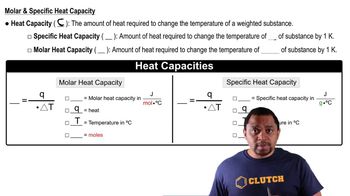
Specific heat capacity is the amount of heat required to raise the temperature of a unit mass of a substance by one degree Celsius. Water has a specific heat capacity of about 4.18 J/g°C. This concept is important for determining how much energy the water loses as its temperature decreases from 8.0 °C to 0.0 °C, which helps in finding the mass of the water sample.
추천 영상: