Ch.7 Chemical Quantities and Reactions
Timberlake - Chemistry: An Introduction to General, Organic, and Biological Chemistry 13th Edition
Timberlake13th EditionChemistry: An Introduction to General, Organic, and Biological ChemistryISBN: 9780134421353당신이 사용하는 게 아니라요?교과서 변경
7장, 문제 75a

How would each of the following change the rate of the reaction shown here?
2 SO2(g) + O2(g) → 2 SO3(g)
a. adding some SO2(g)

검증된 단계별 안내
1
Understand the concept: The rate of a chemical reaction depends on factors such as concentration, temperature, surface area, and the presence of a catalyst. In this case, adding more SO₂(g) affects the concentration of a reactant.
Identify the relationship between concentration and reaction rate: According to the collision theory, increasing the concentration of a reactant increases the frequency of collisions between reactant molecules, which can increase the reaction rate.
Apply the principle to the given reaction: The reaction involves SO₂(g) and O₂(g) as reactants. Adding more SO₂(g) increases its concentration, which leads to more frequent collisions between SO₂(g) and O₂(g) molecules.
Relate this to the rate of reaction: With more frequent collisions, the likelihood of effective collisions (those that result in product formation) also increases, thereby increasing the rate of the reaction.
Conclude: Adding SO₂(g) increases the concentration of one of the reactants, which in turn increases the rate of the reaction according to the collision theory.

비슷한 문제에 대한 검증된 영상 답변:

이 영상 해법은 위 문제에 도움이 된다고 튜터들이 추천한 것입니다.
영상 길이:
3m

주요 개념

질문에 올바르게 답하기 위해 반드시 이해해야 하는 핵심 개념들은 다음과 같습니다.

Reaction Rate

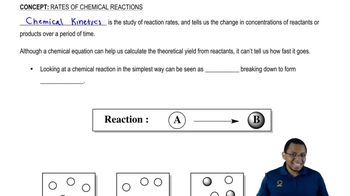
The reaction rate refers to the speed at which reactants are converted into products in a chemical reaction. It can be influenced by various factors, including concentration, temperature, and the presence of catalysts. In this case, the rate of the reaction can be affected by the concentration of SO₂, as increasing the amount of a reactant typically leads to a higher frequency of collisions between molecules, thus accelerating the reaction.
추천 영상:
가이드 코스
01:07
Rate of Reaction Concept 1

Le Chatelier's Principle

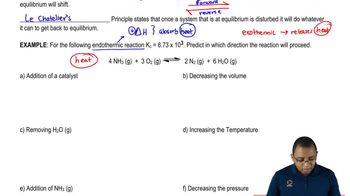
Le Chatelier's Principle states that if a dynamic equilibrium is disturbed by changing the conditions, the system will adjust to counteract the change and restore a new equilibrium. In the context of the given reaction, adding more SO₂ will shift the equilibrium position to the right, favoring the formation of SO₃, thereby increasing the rate of the reaction until a new equilibrium is established.
추천 영상:
가이드 코스
09:34
The following is an endothermic reaction where Kc = 6.73 x 10³.For each of the choices below predict in which direction the reaction will proceed

Concentration Effects

Concentration effects refer to how the amount of reactants or products in a reaction mixture influences the reaction rate. Increasing the concentration of a reactant, such as SO₂ in this case, leads to more molecules available for reaction, which increases the likelihood of collisions and thus enhances the rate of reaction. This principle is fundamental in understanding how varying concentrations can impact chemical kinetics.
추천 영상:
가이드 코스
00:52
Percent Concentrations Concept 1