Ch.9 Solutions
Timberlake - Chemistry: An Introduction to General, Organic, and Biological Chemistry 13th Edition
Timberlake13th EditionChemistry: An Introduction to General, Organic, and Biological ChemistryISBN: 9780134421353당신이 사용하는 게 아니라요?교과서 변경
9장, 문제 15d

Calculate the number of equivalents in each of the following:
d. 3 moles of CO32–

검증된 단계별 안내
1
Understand the concept of equivalents: In chemistry, an equivalent is the amount of a substance that reacts with or supplies one mole of hydrogen ions (H⁺) or electrons in a reaction. For ions, the number of equivalents is determined by multiplying the number of moles by the absolute value of the ion's charge.
Identify the charge of the ion: The carbonate ion (CO₃²⁻) has a charge of -2. This means each mole of CO₃²⁻ can provide 2 equivalents.
Write the formula to calculate the number of equivalents: The number of equivalents is given by the equation: Equivalents = moles × | charge |
Substitute the given values into the formula: Here, the number of moles is 3, and the absolute value of the charge is 2. Substitute these values into the formula: Equivalents = 3 × 2
Perform the multiplication to determine the total number of equivalents. This will give you the final result.

비슷한 문제에 대한 검증된 영상 답변:

이 영상 해법은 위 문제에 도움이 된다고 튜터들이 추천한 것입니다.
영상 길이:
1m

주요 개념

질문에 올바르게 답하기 위해 반드시 이해해야 하는 핵심 개념들은 다음과 같습니다.

Moles

A mole is a unit in chemistry that represents a specific quantity of particles, typically atoms or molecules. One mole is defined as 6.022 x 10²³ entities, known as Avogadro's number. Understanding moles is essential for converting between the mass of a substance and the number of particles it contains, which is crucial for stoichiometric calculations.
추천 영상:

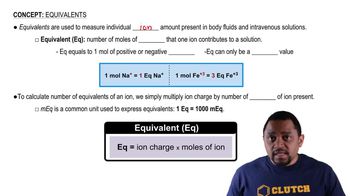
Equivalents

In chemistry, an equivalent is a measure that relates to the reactive capacity of a substance. It is defined as the amount of a substance that can react with or supply one mole of hydrogen ions (H⁺) in a reaction. The concept of equivalents is particularly important in acid-base chemistry and redox reactions, where it helps quantify the amount of reactants needed.
추천 영상:
가이드 코스
01:43
Equivalents Concept 1

Charge of Ions

The charge of an ion indicates its electrical state, which is crucial for understanding its reactivity and interactions in chemical reactions. For example, CO₃²⁻ (carbonate ion) has a charge of -2, meaning it can react with two moles of H⁺ ions. This charge influences how many equivalents of the ion are present in a given number of moles, impacting calculations in stoichiometry.
추천 영상:
가이드 코스
01:16
Polyatomic Ions