Ch.10 Acids and Bases and Equilibrium
Timberlake - Chemistry: An Introduction to General, Organic, and Biological Chemistry 14th Edition
Timberlake14th EditionChemistry: An Introduction to General, Organic, and Biological ChemistryISBN: 9781292472249당신이 사용하는 게 아니라요?교과서 변경
10장, 문제 45c

Complete and balance the equation for each of the following reactions:
c. HCl(aq) + NaHCO3(s) →

검증된 단계별 안내
1
Identify the type of reaction: This is an acid-base reaction where hydrochloric acid (HCl) reacts with sodium bicarbonate (NaHCO₃). The reaction will produce a salt, water, and carbon dioxide gas.
Write the unbalanced chemical equation: HCl(aq) + NaHCO_3(s) → NaCl(aq) + H_2O(l) + CO_2(g). Here, HCl provides the hydrogen ion (H⁺), and NaHCO₃ acts as a base, releasing bicarbonate (HCO₃⁻).
Check the conservation of atoms: Verify that the number of each type of atom on the reactant side matches the number on the product side. In this case, the equation is already balanced as written.
Confirm the physical states of all compounds: HCl is aqueous (aq), NaHCO₃ is solid (s), NaCl is aqueous (aq), H₂O is liquid (l), and CO₂ is a gas (g). These states are important for understanding the reaction conditions.
Summarize the balanced equation: The final balanced equation is HCl(aq) + NaHCO_3(s) → NaCl(aq) + H_2O(l) + CO_2(g). This shows the complete reaction with all products and their physical states.

비슷한 문제에 대한 검증된 영상 답변:

이 영상 해법은 위 문제에 도움이 된다고 튜터들이 추천한 것입니다.
영상 길이:
5m

주요 개념

질문에 올바르게 답하기 위해 반드시 이해해야 하는 핵심 개념들은 다음과 같습니다.

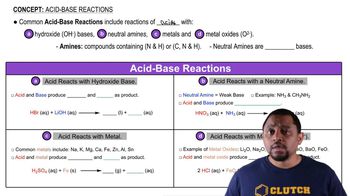
Acid-Base Reactions

Acid-base reactions involve the transfer of protons (H⁺ ions) between reactants. In this case, hydrochloric acid (HCl) acts as an acid, donating a proton, while sodium bicarbonate (NaHCO₃) acts as a base, accepting the proton. Understanding this interaction is crucial for predicting the products of the reaction.
추천 영상:
가이드 코스
03:08
Acid-Base Reactions Concept 1

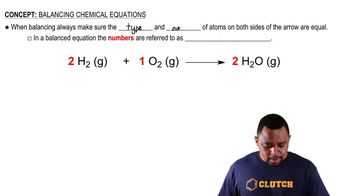
Balancing Chemical Equations

Balancing chemical equations ensures that the number of atoms for each element is the same on both sides of the equation, adhering to the law of conservation of mass. This process involves adjusting coefficients in front of compounds to achieve balance, which is essential for accurately representing the reaction.
추천 영상:
가이드 코스
01:32
Balancing Chemical Equations (Simplified) Concept 1

Products of the Reaction

The reaction between HCl and NaHCO₃ produces carbon dioxide (CO₂), water (H₂O), and sodium chloride (NaCl). Recognizing the expected products helps in balancing the equation correctly and understanding the nature of the reaction, which is a typical acid-carbonate reaction that produces gas.
추천 영상:
가이드 코스
1:08
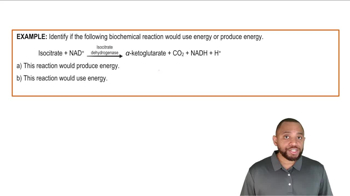
Energy Production In Biochemical Pathways Example 1