Ch.11 Introduction to Organic Chemistry: Hydrocarbons
Timberlake - Chemistry: An Introduction to General, Organic, and Biological Chemistry 14th Edition
Timberlake14th EditionChemistry: An Introduction to General, Organic, and Biological ChemistryISBN: 9781292472249당신이 사용하는 게 아니라요?교과서 변경
11장, 문제 1b

Identify each of the following as a formula of an organic or inorganic compound. For an organic compound, indicate if represented as molecular formula, expanded, or condensed structural formula:
b. CH3―CH2―CH2―CH3

검증된 단계별 안내
1
Step 1: Understand the distinction between organic and inorganic compounds. Organic compounds primarily contain carbon and hydrogen atoms, often with other elements like oxygen, nitrogen, or sulfur. Inorganic compounds typically do not have carbon-hydrogen bonds.
Step 2: Analyze the given formula, CH₃―CH₂―CH₂―CH₃. This structure contains only carbon (C) and hydrogen (H) atoms, which is characteristic of an organic compound.
Step 3: Recognize the type of formula representation. The given formula shows the connectivity of atoms explicitly, with each carbon atom and its attached hydrogen atoms represented. This is known as an expanded structural formula.
Step 4: Confirm the classification. Since the compound contains carbon and hydrogen atoms and is represented in an expanded structural formula, it is an organic compound.
Step 5: Summarize the findings. The compound CH₃―CH₂―CH₂―CH₃ is an organic compound, and its formula is presented as an expanded structural formula.

비슷한 문제에 대한 검증된 영상 답변:

이 영상 해법은 위 문제에 도움이 된다고 튜터들이 추천한 것입니다.

주요 개념

질문에 올바르게 답하기 위해 반드시 이해해야 하는 핵심 개념들은 다음과 같습니다.

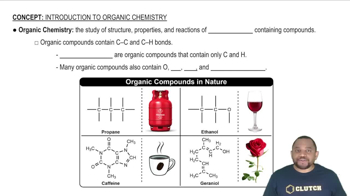
Organic Compounds

Organic compounds are primarily composed of carbon atoms, often in combination with hydrogen, oxygen, nitrogen, and other elements. They are characterized by their carbon-based structures and can form a vast array of molecules, including hydrocarbons, alcohols, and acids. The presence of carbon-hydrogen bonds is a key feature that distinguishes organic compounds from inorganic ones.
추천 영상:
가이드 코스
2:26
Introduction to Organic Chemistry Concept 1

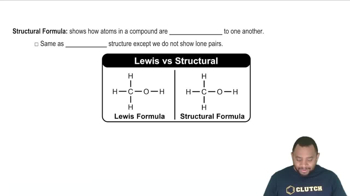
Structural Formulas

Structural formulas represent the arrangement of atoms within a molecule, illustrating how atoms are bonded together. There are different types of structural formulas: molecular formulas show the number of each type of atom, expanded structural formulas depict all bonds explicitly, and condensed structural formulas provide a simplified representation. Understanding these formats is essential for interpreting the structure and properties of organic compounds.
추천 영상:
가이드 코스
1:01
Structural Formula Concept 2

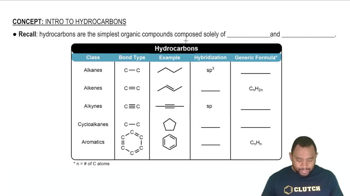
Hydrocarbons

Hydrocarbons are organic compounds consisting entirely of hydrogen and carbon. They can be classified into aliphatic (straight or branched chains) and aromatic (ring structures) hydrocarbons. The example given, CH₃―CH₂―CH₂―CH₃, is a straight-chain alkane known as butane, which is a saturated hydrocarbon with single bonds between carbon atoms, highlighting the fundamental nature of hydrocarbons in organic chemistry.
추천 영상:
가이드 코스
4:29
Intro to Hydrocarbons Concept 1